
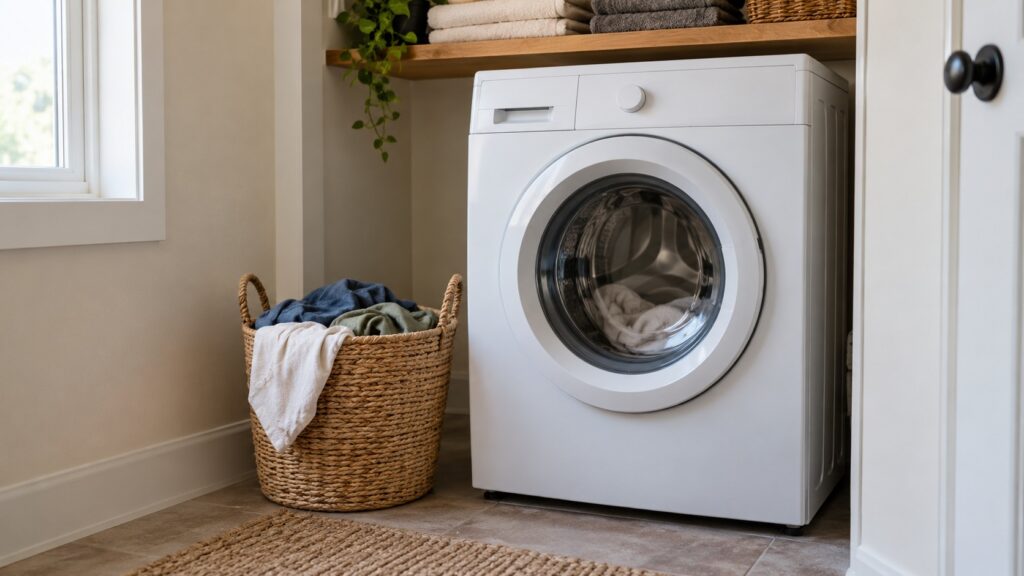
Bosch ActiveWater is the name our model pages use for a feature on some 300 Series compact washers that adjusts the amount of water to the load instead of filling to one fixed level every time. The WAT28402UC page says sensors measure load weight and fabric type, then adjust water volume for efficiency. The WAT28401UC page says ActiveWater adjusts water usage based on load size. Both describe the same idea: less water for a small load, more for a full drum.
What is Bosch ActiveWater?
It is an automatic water-level feature. A basic washer fills to the same height whether you wash two towels or a full load of jeans. A washer with a load-sensing feature measures what you put in and decides how much water the cycle needs. That saves water on small loads and avoids starving a big load of water.
That is all our pages say about how it works. They do not describe the sensor hardware, the water volumes, or the number of load sizes the washer recognizes, and we are not going to guess. For the exact behavior of your machine, the owner’s manual for your model is the source.
Which Bosch washers have ActiveWater?
On our site, two compact washer pages name it. The WAT28402UC is a 24-inch, 300 Series front-load compact washer with a 2.2 cu. ft. drum, 15 wash cycles, a 1,400 RPM maximum spin and ActiveWater Plus. The WAT28401UC is the matching 300 Series model with 15 cycles and ActiveWater listed in its key features. Neither page lists Wi-Fi.
The higher 800 Series washers on our site highlight other features, such as the AquaShield leak protection on the WAW285H1UC or Iron Assist on the WGB24600UC. A feature missing from a model page is not proof that the washer lacks it. Look at the rating plate, the manual or the spec sheet if the question matters for a purchase. Our 500 versus 800 Series washer guide explains how the series differ in general.
What does ActiveWater sense, and what does it change?
Two things are named. On the WAT28402UC the sensors read the weight of the load and the fabric type. On the WAT28401UC the page mentions load size. In both cases the output is the same: the water volume. Our pages do not say that ActiveWater changes anything else, such as the spin; those come from the cycle you choose and are covered in the owner’s manual.
It helps to think of ActiveWater as a layer under the cycle, not a cycle of its own. You still pick a program such as Normal or Delicates. Our Bosch washer cycle settings guide covers what each program is for. ActiveWater then decides how much water that program uses for the load you put in.
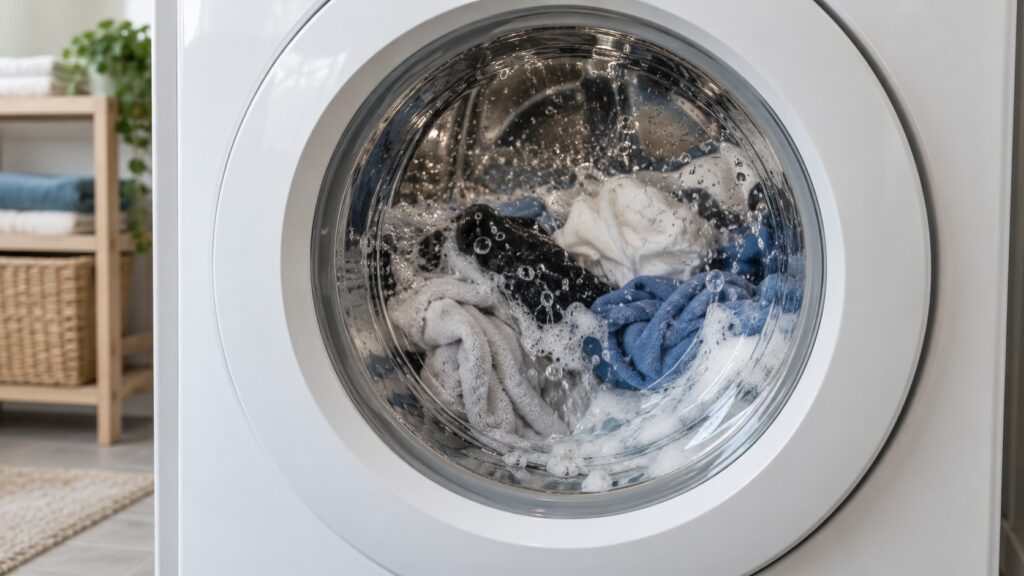
How should you load a washer with ActiveWater?
Treat the sensor as an assistant that works best with an honest load. A few habits make it easier for any washer to size the water correctly.
Load loosely. Items packed tight to the door give a washer less room to spread them and can leave the middle of the load dry. Mix large and small pieces rather than washing one heavy item alone, because a single heavy item often makes a washer unbalanced. Do not add a very small number of items to a drum meant for a full load if the manual advises otherwise.
Use detergent in the amount shown in your owner’s manual and on the detergent label. More detergent does not make clothes cleaner, and a feature that adjusts water does not remove the need to measure.
How is ActiveWater different from AquaStop, EcoSilence and SpeedPerfect?
These names appear together on the same model pages, so they are easy to confuse.
A washer can have all four and still fill with too little or too much water if something upstream or downstream is wrong, because ActiveWater only controls the target, not the plumbing.
How do load-sensing washers decide how much water to use in general?
The general idea is the same across brands: the washer reads something about the load and uses it to set the water target. Dry cotton soaks up a lot of water, while a small synthetic load needs little, so a fixed fill level wastes water on one and shortchanges the other. A load-sensing washer lets the load set the target rather than a single preset height.
How your exact model does it, including how many load sizes it tells apart and which cycles use it, is in the owner’s manual. Leave a running cycle alone, and open the door only when the washer unlocks it.
What if the water level looks wrong?
Start with what you can see and reach safely. Confirm that both water supply valves are open and that the fill hoses are not kinked or crushed behind the washer. If the washer drains slowly or leaves water in the drum, the usual suspect is the drain pump filter; our drain pump filter cleaning guide shows where it is and how to clear it. Do it only with the washer unplugged and a dry floor, and keep a towel and a shallow tray handy, because the filter holds water.
Do not open the cabinet, remove panels or try to test the sensor yourself. If water is on the floor near the outlet or the cord, switch off the breaker at the panel while standing on a dry floor, and do not pull the plug out of a wet outlet. A fault that looks like a water-level fault, such as a washer that will not fill, keeps overfilling or stops with an error code, is a job for a technician. You can read how that works on our washer repair page.