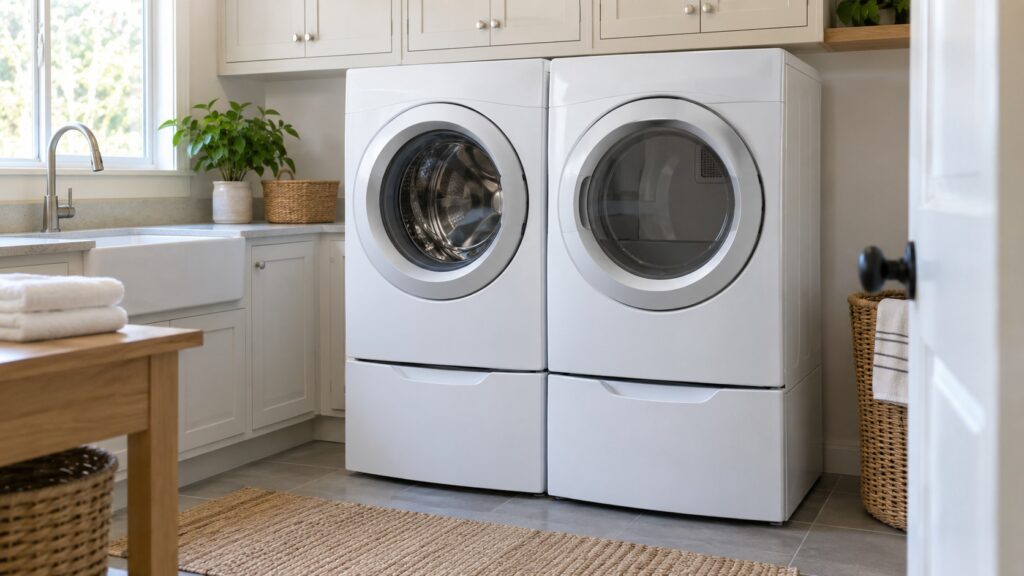
A Bosch washer pedestal installation comes down to four decisions: whether the pedestal is made for your exact washer, whether the floor and the room can take the extra height, how the washer is secured to the pedestal and how the finished stack is leveled. A pedestal raises the washer so the door and the drum are easier to reach, and some laundry pedestals add a storage drawer underneath. It is not a universal accessory, and the instructions that come with your washer and with the pedestal are the authority for every fixing, clearance and tightening step.
What is a washer pedestal and why use one?
A pedestal is a platform that the washer sits on. Front-load washers have the door near the bottom of the cabinet, so you bend down to load and unload them, and raising the washer brings the door closer to waist height. It also lifts the washer away from a floor that may get wet. Some pedestals include a drawer for detergent and other laundry items, which uses the space that would otherwise be empty.
Our site lists compact Bosch washers, for example the WGA24400UC, a 24-inch front-load compact washer, and the WAW285H1UC. Compact washers are a smaller size than full-size machines, but a pedestal can still make loading more comfortable. How a pedestal is made for your model, which one fits and what it weighs are details for your owner’s manual and the pedestal’s own instructions; our pages do not list them.
Does every pedestal fit every Bosch washer?
No. A pedestal is designed around the footprint and the mounting points of a particular washer, and the pedestal’s feet have to carry the washer’s weight with the right fixings. Check the manual for your washer, or its spec sheet, for the pedestal and the fixing kit it calls for, and do not buy a pedestal because it looks the right size. A pedestal that does not match the washer can wobble, let the washer move during the spin or fail to hold it securely.
The same is true of stacking a dryer on top of a washer, which is a different arrangement. Our Bosch washer and dryer stack installation guide says a stacked set needs the correct stacking kit and adequate structural support. A pedestal is not part of a stack, so do not combine the two unless your manual says you can.
What should you prepare before you lift the washer?
Do the work that is easiest while the washer is still on the floor. Read the installation pages of the manual, check the pedestal’s contents against the parts list and clear a path from the pedestal’s place to where the washer will go. Measure the height available. A taller stack needs headroom under cabinets and shelves and enough room behind the machine for the hoses and the door to swing.
If the washer is new, the transit bolts have to come out before it runs. Our stack installation guide lists removing the shipping bolts as a critical step, because leaving them in damages the drum suspension. Remove them according to your manual, and keep them in case you move the washer again.
Shut off the hot and cold supply valves and unplug the washer before you move it (if the outlet or floor is wet, switch off the breaker at the panel instead and do not touch the plug), and have the hoses and drain hose free enough to let the washer move without pulling them. If the washer is already connected, put a towel and a shallow tray under the hose ends, since hoses hold water.
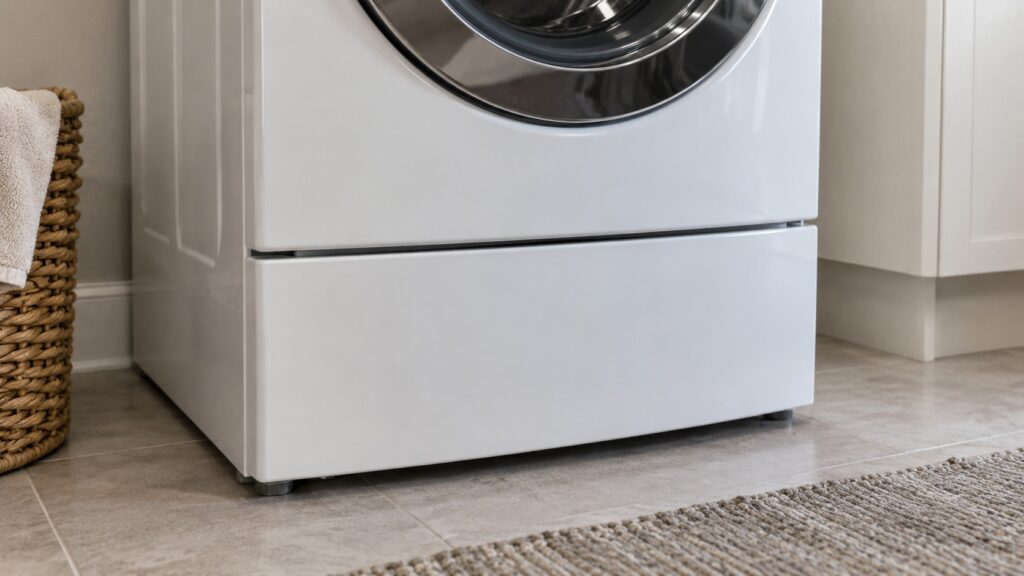
How do you put the washer on the pedestal safely?
A washer is heavy, and a pedestal adds height, so a mistake here is how people get hurt. Get a second person. Protect the floor with cardboard or a blanket. Lift with your legs, keep the washer upright and do not tip it onto its back or its door. A washer should never be lifted by its door, the top or the control panel.
Follow your manual for how the washer attaches to the pedestal. Whether the washer is held by fixings or a bracket, and which ones, depends on the pedestal and the washer, and an unsecured washer can move during a hard spin. If your manual does not describe a fixing for the combination you have, stop and ask before going further. Do not drill, bolt or glue anything that the manual does not show.
Keep your fingers clear of the gap between the washer and the pedestal as it goes down. When it is on, make sure the feet or fixings are seated and the washer does not shift when you push on it gently from each side.
How do you level and connect it?
Level matters even more on a pedestal, because a lean is easier to notice and the washer sits higher. Place a level on top of the washer, check it side to side and front to back and adjust the washer’s feet or the pedestal’s adjustable feet as your manual shows, in small steps. Tighten any lock nuts once it is level, and push on each corner to check that no foot is hanging.
Then reconnect the hoses. Use the hoses supplied or the ones your manual specifies, and hand-tighten the fittings as the manual describes. Open the supply valves slowly and look for drips at each connection. Check the drain hose is secured at the standpipe or the drain and cannot slip out while the washer drains. Run a short cycle with an empty drum and watch for leaks and for movement.
If the stack shakes or walks during the spin, stop the cycle. Our Bosch washer vibration guide explains the usual causes, starting with an unlevel washer, transit bolts left in and an unbalanced load.
What problems are most common after installation?
The three that matter are movement, noise and leaks. Movement and noise nearly always mean a level or a fixing problem. A leak at a fitting after the washer was moved means a hose was disturbed. If the washer shows an error code, look it up in our Bosch washer error codes reference. If there is water near the outlet, switch off the breaker at the panel while standing on a dry floor, and do not pull the plug from a wet outlet.
Do not open the cabinet or remove panels to fix a problem after the washer is in place. That is a technician’s job. We are an independent repair company, not the manufacturer, and our Bosch washer repair page explains how a visit works.