A Bosch washer bearing failure usually announces itself as a rumbling or grinding noise that gets louder during the spin cycle, sometimes with a slow leak from under the drum. Repairing the bearings is a major job, because the drum has to come out, so the decision depends mostly on the age of the washer and on whether anything else is failing. A newer washer is usually worth repairing; an old one with other problems often is not. A technician has to confirm the diagnosis before you decide.
What does a failing Bosch washer bearing sound like?
Our washer vibration guide describes worn drum bearings as producing a rumbling or grinding noise that increases during spin. It is a low, rolling noise, not the thump of an unbalanced load or the rattle of a coin in the drum. A load that is lopsided, a washer that is not level or shipping bolts that were never removed cause violent vibration too, so rule those out first. Our guide to Bosch washer vibration issues lists them in order.
The noise matters most when it keeps going after the easy causes are fixed. A washer that is level, loaded evenly and still rumbles during every spin has a mechanical problem, and the bearings are one of the usual suspects. Shock absorbers and suspension springs are others, and a technician can tell them apart quickly.
How can you check the bearings without taking anything apart?
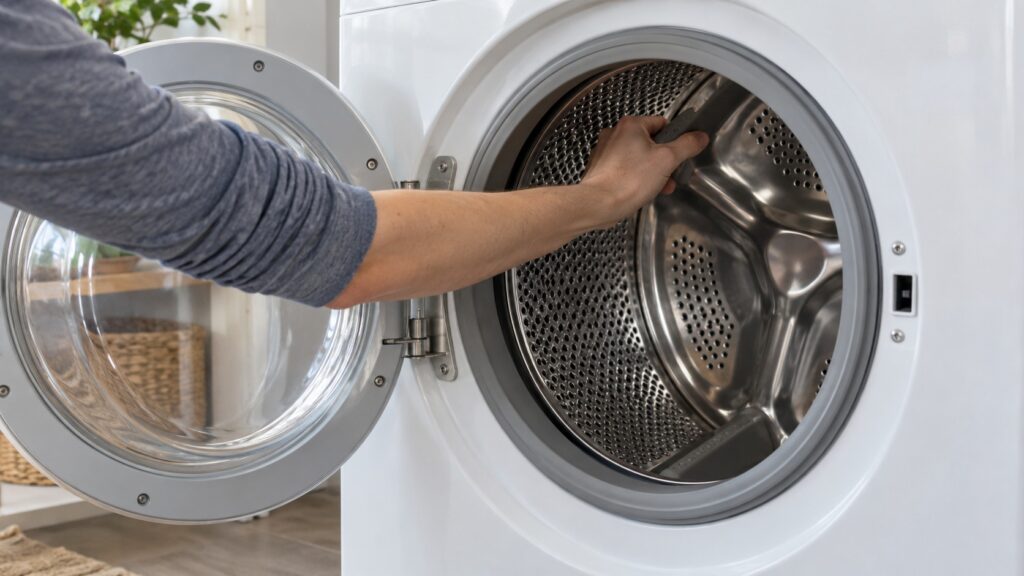
With the washer off and empty, open the door and turn the drum by hand. It should turn smoothly and quietly, and any grinding or roughness points to bearing wear. Our repair-or-replace guide adds a second check: take hold of the drum through the door opening and try to rock it up and down. Noticeable play, more than a quarter inch according to that guide (a rule of thumb, not a Bosch specification), suggests worn bearings. Rock it gently, and never touch the drum while the machine is running.
This is a check, not a diagnosis. Do not open the cabinet or take off any panel to look for the bearings. They sit behind the drum, and reaching them is a technician’s job. If the drum feels rough or loose, note what you found and when the noise happens, and book a visit.
Why is a bearing repair such a big job?
Our guide to Bosch washer leaks explains that the tub seal and the bearing sit behind the drum, where the shaft passes through the outer tub. A worn seal leaks slowly from under the drum, often most noticeable after spin cycles, and is frequently accompanied by a rumbling noise because the bearings behind it are compromised too. The same guide says that replacing the tub seal and the bearing is a major repair that needs the drum to be completely disassembled. The vibration guide agrees that bearing replacement involves removing the drum.
That is why a bearing repair is not comparable to a door lock or a drain pump. It takes specialized tools and time, and the seal should be replaced with the bearing, as our repair-or-replace guide recommends. Ask the technician to include the seal in the estimate, and ask for the estimate in writing before work begins.
Should you repair or replace a washer with bad bearings?
Our Bosch washer repair or replace guide uses age as the starting point. Its framework says that bearings failing in the first five years are unusual for Bosch but worth repairing, and that you should check the warranty because premature failure may be covered. For a washer between about six and nine years old it says the repair is likely worth doing, as long as the tub seal is replaced at the same time and nothing else major is failing. At ten years or more it says the decision likely tips to replacement, because other parts such as the control board or shock absorbers may fail soon after. Those age bands are our guide’s rule of thumb, not a Bosch figure, and the owner’s manual and warranty terms for your model come first.
The guide also warns about repeated repairs. One repair on a seven-year-old washer is normal, while several in a short period is a pattern. Count what you have already spent on the machine before committing to a major repair. Our Bosch washer repair page explains how a diagnostic visit works. We give you an honest recommendation, and where a repair is not worth doing, we say so.
What should you do while you decide?
If the washer is making a loud grinding noise or leaking, stop using it until it is checked. If water reaches the floor near an outlet or a cord, switch off the breaker at the panel while standing on a dry floor, and never pull a plug from a wet outlet. Keep a towel under the front and watch for water after each use.
Write down the model number and serial number from the rating plate, the date you bought the washer and any repairs it has had. That history is what makes a repair-or-replace conversation useful. If your washer shows a motor or drum error code rather than a noise, look it up on our Bosch washer error codes reference first.