
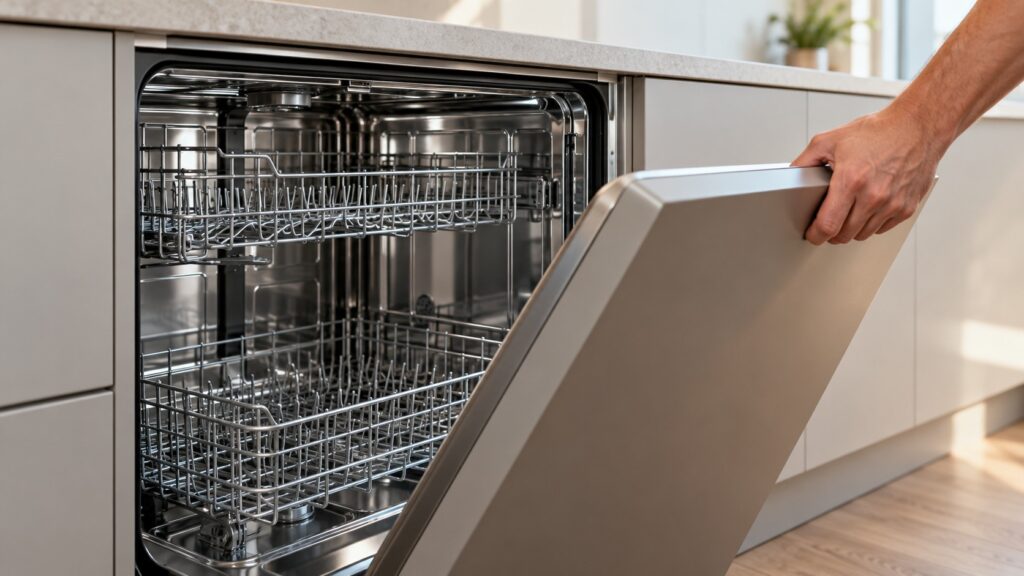
A Bosch dishwasher water softener is a built-in unit that removes the minerals that make water hard before that water reaches the dishes and the heater. It does this with a resin that traps the minerals, and it cleans itself with salt that you add to a small reservoir in the bottom of the tub. When the softener is supplied with salt and set to match your water, glassware stays clear and the heater stays free of scale. When it runs out of salt or is set wrong, you see white film, spots and sometimes slow heating. This guide explains how the system works, how it differs from rinse aid and descaling, and what is safe for an owner to do.
What does the water softener in a Bosch dishwasher do?
Hard water carries dissolved calcium and magnesium. When that water is heated and then dries on a surface, the minerals are left behind as a white, chalky film. In a dishwasher this shows up in two places: on the dishes, where it looks like cloudy glasses and white spots, and on the heater, where it builds into scale that slows heating. The softener sits in the water path before the wash and swaps the troublesome minerals for something that does not form scale. The result is that detergent works better, glassware dries clearer and the heating parts are protected.
Not every Bosch dishwasher you may find in a home is the same, and our model pages do not list a softener as a specification. Whether your unit has the reservoir, where the cap is and what the control looks like are all model details. Your owner’s manual is the source, and the model number is what you need to find the right one.
How does the salt keep the softener working?
The softener resin can only hold so many minerals. When it is full, it stops softening, so the machine periodically cleans it, a step called regeneration. The salt is what makes that cleaning work: it is dissolved into a brine that flushes the trapped minerals out and down the drain, which leaves the resin ready to soften again. This is why the salt is not a seasoning for the dishes. It never ends up on the plates, and it is used up slowly over many cycles.
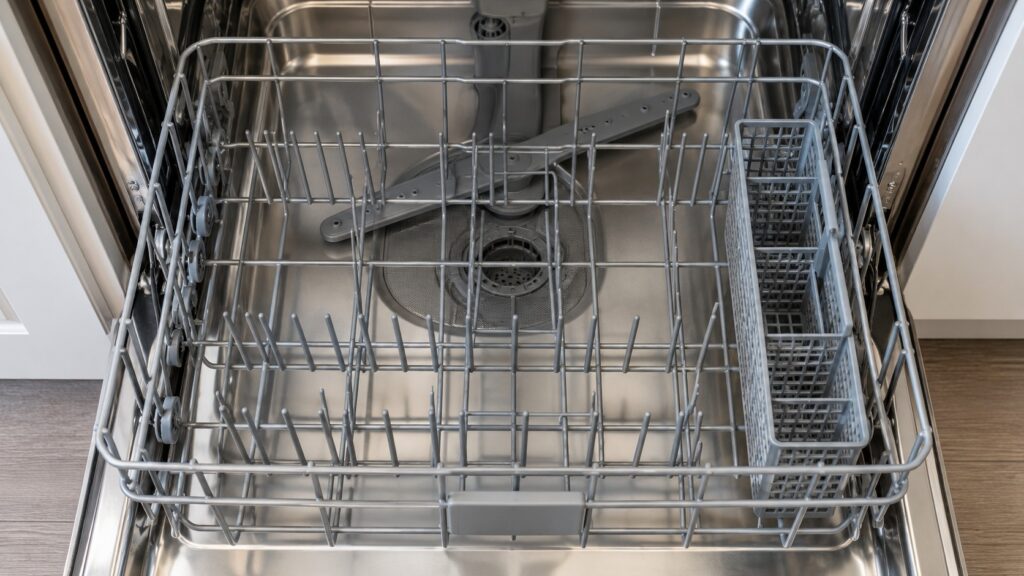
Our page for the Bosch dishwasher E12 code describes the salt reservoir as a cap at the bottom of the dishwasher tub and says to use dishwasher salt, not table salt. Follow that and your manual. The manual also tells you how to fill the reservoir and what to do about spilled grains. We do not give amounts here, because the right quantity depends on the model.
How do you set the hardness level?
The softener works best when its setting matches the hardness of your water. Our AquaSensor guide puts it simply: set it once, correctly, from a water hardness figure rather than a guess. Set too low, and the system lets minerals through, so scale builds up; the guide adds that a setting that is too high wastes salt and can etch glassware over years. A water test strip kit is inexpensive, and your water utility can often give you a figure for your area.
How you change the level, and what the numbers represent, depends on the model. The method differs by model, and we do not list any button sequences here, because a wrong one can change other settings. Look in your owner’s manual for the section on water hardness, and use the exact steps it gives.
What is the difference between the softener, rinse aid and descaling?
The three are often mixed up. The softener treats the water before it reaches the dishes. Rinse aid is a liquid that helps water sheet off the dishes at the end so they dry with fewer spots, and it has its own dispenser; our rinse aid dispenser guide explains it and how the right setting depends on water hardness. Descaling is a cleaning step that removes scale that has already formed. A softener that is working reduces the need for descaling, and a rinse aid helps drying, but neither replaces the other.
Think of it as a chain. Soft water cleans well and does not scale. Rinse aid helps the final rinse. Condensation drying then depends on warm, clean surfaces, which is covered in our Bosch dishwasher drying tips. If one link is missing, results suffer even when the others are fine.
What are the signs the softener needs attention?
The usual clues are a white film on glassware that wipes off with a cloth, white spots that return after every cycle even when rinse aid is full, a chalky coating inside the tub, and longer cycles. A salt indicator on the panel, where the model has one, is the first thing to check. The simple owner steps are to fill the salt reservoir if it is empty, wipe off spilled grains, and make sure the hardness setting matches your water, all as your manual describes.
If scale has already built up on the heater, the machine may report slow heating or a limescale code. Our guide to dishwasher heating element problems covers that side. Do not open the base or door panel to look at the resin, the valve or the heater; those parts sit next to wiring and water connections, and that is work for a technician.
When should you call a technician?
Call when salt and the correct setting do not stop the film, when the machine reports a limescale or heating code that returns, or when you see water around the base. If you notice a burning smell, switch the breaker off at the panel while standing on a dry floor and stop using the dishwasher. We are an independent repair company, not the manufacturer. Our Bosch dishwasher repair page explains how a visit works, and you can schedule a visit online.