Bosch AquaSensor is an optical sensor that measures how dirty the wash water is and lets the dishwasher decide what to do next. It is the difference between a machine that runs a fixed program and one that adapts: a lightly soiled load finishes sooner and with less water, and a heavily soiled one gets an extra fill instead of coming out disappointing. It is also the reason your cycle time varies from load to load on a program you never changed.
How the measurement actually works
The sensor is a simple optical pair: a light emitter on one side of a small window and a receiver on the other. Clean water passes light through almost unimpeded. Water carrying grease, starch and food particles scatters and absorbs it, so less light arrives. The control board reads that difference and infers how soiled the load is.
It takes that reading more than once. An early measurement decides how hard to wash; later measurements decide whether the water is clean enough to reuse for the next phase or should be dumped. That second decision is where most of the water saving comes from — a machine that can safely carry water forward skips a whole fill.
Why your cycle time keeps changing
This is the question we are asked most about it. A program with a stated time of, say, two hours is stating a typical case. Put a lightly soiled load in and the sensor reports clean water early, the machine shortens the wash and drops a rinse, and the cycle finishes well under the estimate. Put a roasting pan in and it does the opposite.
The displayed remaining time therefore moves during the cycle, sometimes jumping several minutes at once. That is the machine revising its own estimate after a measurement, and it is correct behavior. Our guide on Bosch dishwasher cycles and settings covers which programs lean on the sensor most.
Pre-rinsing works against it
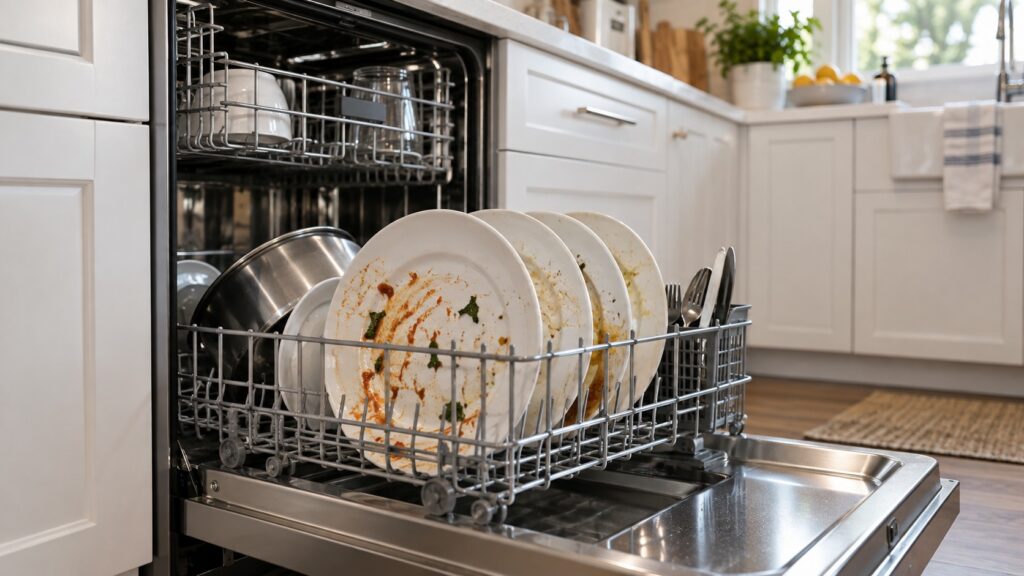
If you rinse every plate under the tap before loading, the sensor sees clean water at the first measurement and runs the shortest, gentlest wash it can. On a genuinely light load that is fine. On a load where baked-on residue remains under an otherwise rinsed surface, the machine has been told the load is clean and will act accordingly.
Scrape rather than rinse. Remove bones and paper, leave the rest, and let the machine measure something real. This also saves the water you were using at the tap, which is usually more than the dishwasher would have used. Our guide to loading mistakes covers the rest.
What the sensor cannot see
Turbidity is a good proxy for soil and a poor proxy for two things. It cannot tell grease from starch, so a load of oily pans and a load of pasta water read similarly while needing different temperatures. And it measures what is in the water, not what is still stuck to a plate — a casserole dish with a baked-on crust that has not yet softened contributes almost nothing to the reading during the early measurement.
This is why the program you choose still matters. An intensive program does not just wash longer; it washes hotter, which is what lifts baked-on residue in the first place and gives the sensor something to measure. Choosing a short program and trusting the sensor to compensate asks it to do a job it cannot do.
Hard water changes what “clean” reads like
In a hard-water area the water arriving at the machine already carries dissolved minerals. They do not scatter light the way food particles do, so they are largely invisible to the sensor — but they very much affect the result on your glassware. A machine can therefore read clean water, shorten the cycle, and still leave a cloudy film on everything.
The fix is not at the sensor. It is the machine’s own water softener, kept supplied with salt and set to the correct hardness for your supply. Set it once, correctly, from a water hardness figure rather than a guess: set too low it scales, set too high it wastes salt and can etch glassware over years.
What goes wrong with it
The sensor has no moving parts, and there are only two realistic failure modes. The first and far more common is a filmed-over window: limescale in a hard-water area, or a greasy deposit from long-term low-temperature cycles, coats the glass and the sensor reads dirty water even when the water is clean. The symptom is a machine that suddenly runs very long cycles on every load.
The second is an electrical failure of the sensor or its wiring, which usually presents as a machine defaulting to a fixed program and losing the variability entirely. That is a diagnosis rather than a cleaning job — see the dishwasher error code archive for what the display is reporting.
Keeping it reading honestly
Three habits keep the window clear. Run a hot maintenance or intensive cycle every couple of months so deposits do not build up in the parts you cannot reach. Keep the rinse aid topped up, because dry surfaces do not deposit film. And in a hard-water area, keep the machine’s own water softener supplied with salt — an unsoftened machine scales everything in the water circuit, the sensor window included.
Our guide on spray arm maintenance covers the rest of the wash circuit, and the CrystalDry explainer covers the drying end of the same cycle.
When to call
A machine that runs very long cycles on every load, one that no longer varies its cycle time at all, or one that leaves residue on a program that used to work — those are worth having looked at rather than worked around, because each of them wastes water and time on every load until it is fixed.
We are an independent repair company, not a factory service arm. Pricing starts from a diagnostic visit and we confirm the estimate before any work begins. Bosch dishwasher repair covers the wash circuit and its sensors, and you can schedule a visit online.