Most of what people call a dryer fault is a dryer being asked to work through a restriction. Bosch dryers — vented and heat pump alike — are sensitive to airflow in a way that shows up as long cycles, clothes that come out warm and damp, or a machine that shuts down partway through. These Bosch dryer tips are the habits that keep that from happening, and the checks that tell you when something really has failed.
Airflow decides almost everything
A dryer removes water by moving air. Anything that slows the air slows the drying, and the machine compensates by running longer rather than by complaining. That is why a duct problem is so often diagnosed as a failing appliance: the symptom is a cycle that used to take 45 minutes and now takes 90, and nothing on the display says why.
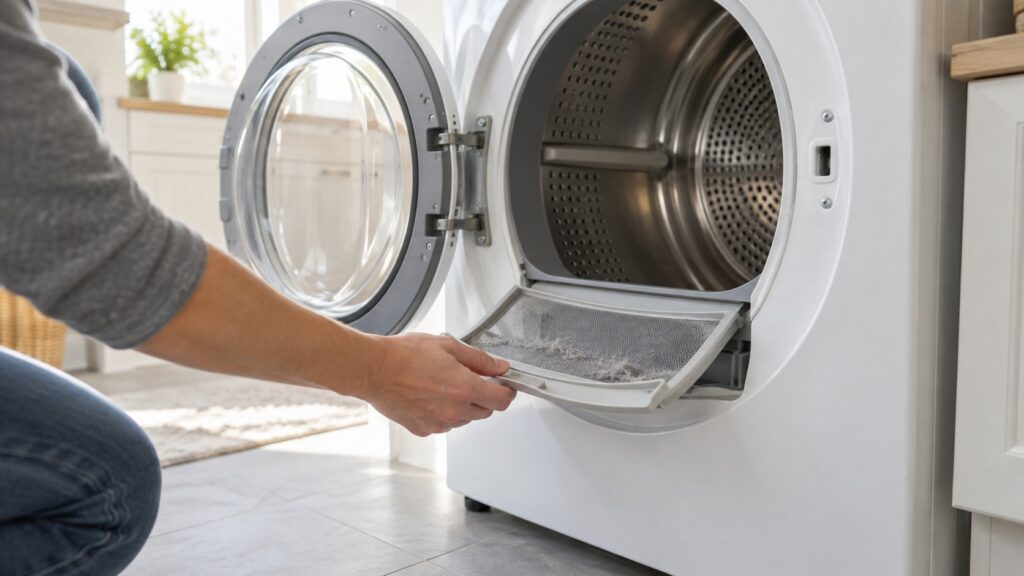
On a vented dryer, the whole path matters — the filter, the internal duct, the hose behind the machine, the run through the wall, and the flap on the outside. A flap held shut by paint, by a bird’s nest or by lint packed behind it defeats a perfectly good machine. On a heat pump model there is no duct, and the equivalent restriction is the condenser filter, which is exactly as easy to neglect.

The lint filter, and what “clean” means
A filter that looks clean can still be blocked. Fabric softener and dryer sheets leave an invisible film on the mesh that sheds water rather than passing air. The test is simple: run water from the tap onto the filter. If it pools instead of running straight through, the mesh is filmed over and needs washing with warm soapy water and a soft brush.
Dry it completely before refitting. A wet filter back in the machine collects lint into a paste on its first cycle, which is worse than not cleaning it at all.
Loading, and the habits that cost you time
- Do not overfill. Clothes have to tumble to dry. A packed drum dries the outside of the load and leaves the middle damp, and the sensor reads the tumbling surface.
- Do not mix weights. Towels and shirts in one load means the shirts are over-dried by the time the towels are done.
- Spin harder in the washer. Water removed mechanically costs nothing; water removed with heat costs the whole cycle. This is the cheapest single improvement available.
- Shake items out before loading. A twisted sheet dries as a rope and comes out creased and damp in the middle.
Sensor drying, and why it sometimes stops early
Sensor programs measure the moisture in the load through metal strips inside the drum and stop when the reading says dry. That works well and fails in two specific ways. Fabric softener residue on the strips insulates them, so they read dry early and the cycle ends with damp clothes. And a very small load may not make contact with the strips often enough to be measured at all.
Wipe the sensor strips with a cloth and a little vinegar every few months, and use a timed program for single items. If a sensor program ends early on every load and the strips are clean, that is worth investigating rather than working around — our explainer on heat pump drying covers what the machine is measuring.
Heat pump models: the same rules, different parts
A heat pump dryer moves heat rather than making it, and it runs at a lower temperature over a longer cycle. That is normal and it is gentler on fabric. What it adds is a condenser and a condensate path, and both need attention that a vented machine does not. The condenser filter rinses out under the tap; the water container empties, or the drain hose has to run without a rise in it that the pump cannot clear.
A heat pump dryer that has become slow is almost always a filter or a condenser matted with lint rather than a failing compressor. Our guide on what a heat pump dryer is covers the mechanism.
The duct run, and the three faults built into it
On a vented machine the duct is part of the appliance whether the installer treated it that way or not, and three things go wrong in it. The first is material: flexible foil and plastic ducting collapse at the bends and catch lint on every ridge, and rigid or semi-rigid metal is the only thing that should be behind a dryer. The second is length: every model specifies a maximum equivalent run, and each elbow counts as several feet against it. A run that meets the number on a drawing and fails it in the wall is common.
The third is the termination. A wall cap with a fine mesh screen — fitted to keep insects out — blocks with lint within months and is the single most common hidden restriction we find. The cap should have a flap, not a screen, and the flap should fall shut under its own weight when the dryer stops.
Noise, and what each kind means
A dryer is not silent, but its noises are distinguishable. A low rumble that rises and falls with the drum is normal. A rhythmic thump that keeps time with rotation is usually something in a pocket or a shoe in the load. A continuous squeal that changes with drum speed points at a roller or an idler pulley. A grinding that appears under load and not empty points at a bearing.
The one worth acting on immediately is a sharp scraping, which is a drum that has dropped onto something it should not touch and will damage the drum if the machine keeps running. Stop, empty it and look before the next cycle.
What is not a habit problem
Some symptoms are the appliance. A drum that will not turn, a burning smell, a door that no longer latches, a machine that trips the breaker, or one that heats on some cycles and not others — those are parts, not routines. We cover a burning smell from a Bosch dryer and door seal and latch problems separately, and the dryer error code archive covers what a display is reporting.
We are an independent repair company, not a factory service arm. Pricing starts from a diagnostic visit and we confirm the estimate before any work begins. Bosch dryer repair covers both vented and heat pump machines, and you can schedule a visit online.