The Bosch WTG865H4UC is an 800 Series heat-pump dryer, and the thing that sets it apart from most dryers on a showroom floor is what it does not need: no dedicated 240-volt outlet, no exterior vent run through a wall or a roof. It dries a load by moving air through a sealed condenser loop instead of pushing hot exhaust outside, which is why it can go almost anywhere a washer already sits, including a closet or an upstairs laundry room with no outside wall nearby.
What makes a heat-pump dryer like the WTG865H4UC different?
A conventional electric dryer heats air, pushes it through the drum once, and vents the moisture-laden exhaust straight outside. A heat-pump dryer like the WTG865H4UC instead recirculates the air through a closed loop: warm, moist air passes over a cold evaporator coil, the moisture condenses out and drains away, and the same air is reheated and sent back through the drum. Nothing leaves the machine except the water it pulls out of your clothes, which is why there is no vent hose and no outside opening to plan for.
The practical upside is installation freedom. A dryer that does not vent can sit in an interior closet, a basement corner, or an upstairs laundry nook that would be impractical to duct to an exterior wall. The trade-off is time: because the drying air runs at a gentler temperature than a vented dryer’s exhaust, a full cycle on a heat-pump dryer typically runs longer than the equivalent load on a standard electric machine. Most owners find the extra time is a fair exchange for not needing ductwork and for the lower energy use that comes with a heat pump doing the work instead of a resistive heating element running at full power the whole cycle.
How does AutoDry sensing change how you use it?
AutoDry uses a moisture sensor rather than a fixed timer to decide when a load is actually dry, and it ends the cycle at that point instead of running a set number of minutes regardless of the load. On a heat-pump dryer this matters more than it does on a vented machine, because overdrying a load wastes more of a heat pump’s more gradual heat cycle than it wastes on a machine that is already running hot. In practice, that means you can load the WTG865H4UC and walk away without guessing at a time setting for a mixed load of towels and lighter items — the sensor is doing that job.
It is worth knowing that AutoDry reads moisture through the fabric a sensor bar contacts, so a very small or unevenly distributed load can sometimes read as dry before it fully is. A quick check partway through a first few loads on a new machine will tell you how it is calibrated for your typical wash.
What does the self-cleaning condenser mean for upkeep?
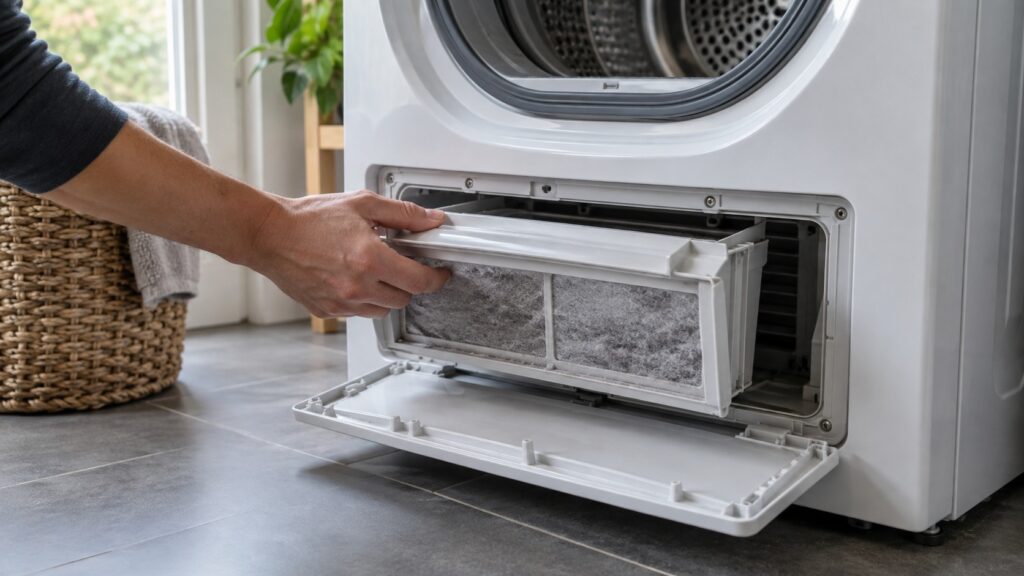
The condenser is the part of a heat-pump dryer that does the work a vent hose does on a conventional machine, and because nothing is venting outside, keeping that condenser clear matters more here than lint filter maintenance does on a vented dryer. The WTG865H4UC’s self-cleaning condenser rinses itself periodically during use to keep lint and fiber from building up on the coil, which reduces how often the condenser needs to be pulled and cleaned by hand — but it does not eliminate that job entirely.
The lint filter inside the drum still needs emptying after most loads, the way it would on any dryer, and the condenser housing benefits from an occasional manual rinse even with self-cleaning running in the background. Our heat-pump dryer maintenance tips guide covers the condenser-cleaning schedule in more detail, and it is worth reading before the first sign of a load coming out less dry than expected.
Where should a ventless dryer like this actually go?
Because the WTG865H4UC does not need an exterior vent, the usual planning question shifts from “can we reach an outside wall” to “does this space drain and does it have enough clearance to breathe.” The unit still needs a way for the condensed water to leave — either a drain hookup or a removable tank that gets emptied — and it needs enough clearance around the cabinet for air to circulate, since a heat pump rejects some heat into the room the same way a small refrigerator does. A closet installation should leave the door able to stay open a crack during a cycle, or use a louvered door, rather than sealing the machine into a small, airtight space.
Stacking is common with a matching Bosch washer, and our washer-dryer stack installation guide covers the kit and the clearance that stacking requires. If you are still deciding between a heat-pump dryer and a standard vented model for the room you have, our heat-pump dryer glossary entry is a useful primer on the underlying technology before you commit to a specific model.
Is the WTG865H4UC the right dryer for your laundry room?
If your laundry space has no easy path to an exterior wall, or if you are converting a closet or an upstairs room into a laundry area, the flexibility this dryer offers is the whole reason to consider it — a vented dryer simply is not an option in some of those spaces without expensive ducting work. If your existing laundry room already has a straightforward vent run and you are simply replacing a worn-out machine, a heat-pump dryer is a smaller upgrade: you gain lower running costs and quieter operation, but you give up some cycle speed. Roughly, expect to trade cycle time for flexibility and efficiency, and plan on the drain or tank detail before delivery day, not after.
We are an independent repair company, not a factory service arm. Pricing for service starts from a diagnostic visit and we confirm the estimate before any work begins. Bosch dryer repair covers the WTG865H4UC and the rest of the heat-pump dryer lineup, and you can schedule a visit online or call 1-844-731-6692.