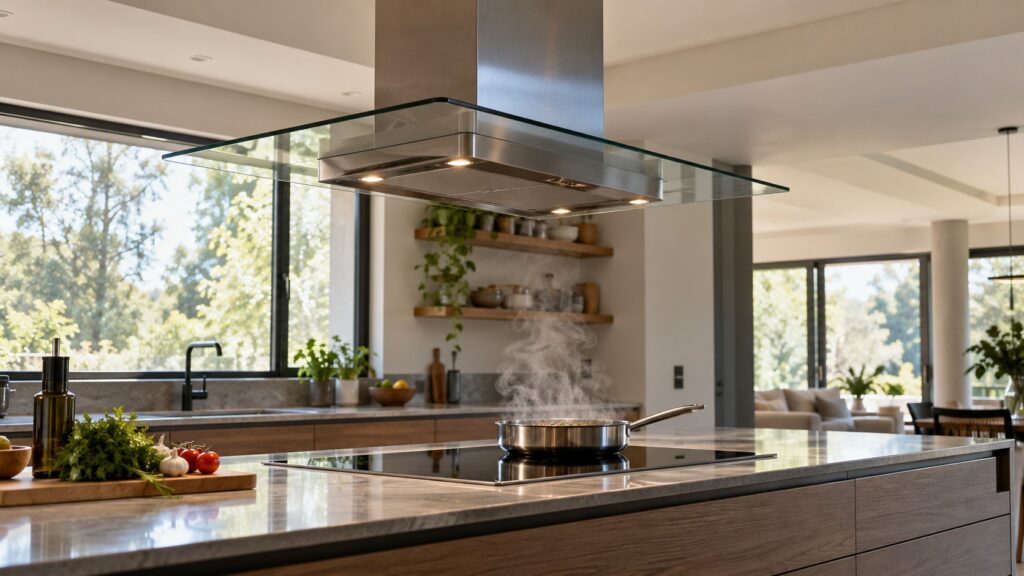
A Bosch vent hood heat sensor watches for rising heat above the cooktop and raises the fan speed on its own, so the hood works harder when the cooking gets hotter. On our site this is described on the page for the Bosch HUI80553UC, a 36-inch island chimney hood, and on two other hood model pages. This guide explains how that kind of sensor works in plain terms, what the HUI80553UC page says about it, what you can and cannot expect from it, and what to do if the fan behaves in a way you do not like.
What does a heat sensor do in a Bosch vent hood?
A heat sensor is a small temperature-sensing part built into the hood. It reads the temperature of the air rising from the cooktop. When that air gets hotter, the control board in the hood can respond by increasing the fan speed without you touching a button. When the air cools, the fan can slow down again. The point is convenience and consistency: you do not have to notice that a pan has started to smoke and reach for the control, and you do not run a loud fan at high speed when the pan is only simmering.
Our page for the Bosch HUI80553UC says exactly this: a 600 CFM blower with an integrated heat sensor that automatically boosts the fan speed when it detects rising temperatures from the cooktop below. We do not publish the temperature at which it reacts or how much it raises the speed, because the page does not give those numbers and they are not ours to guess. The owner’s manual for your model is the place for them.
How does the HUI80553UC use it with the rest of the hood?
The HUI80553UC is a ceiling-mounted island hood, 36 inches wide, for kitchens where there is no wall behind the cooktop. The page lists four speed settings, a 600 CFM blower, LED lighting and an LCD touch display with a timer. It also describes perimeter aspiration, which is a way of drawing smoke and steam in along the edges of the hood, and a delayed shut-off that keeps clearing leftover cooking vapors after you finish.
The heat sensor sits alongside these features. In general, you can think of the speed settings as your manual choice and the heat sensor as an automatic boost that works with them. How exactly the sensor and your manual setting interact, for example whether it only ever raises the speed or whether it also changes your setting back, is a detail of the control software, so read the section on automatic functions in your owner’s manual.
Does every Bosch hood have a heat sensor?
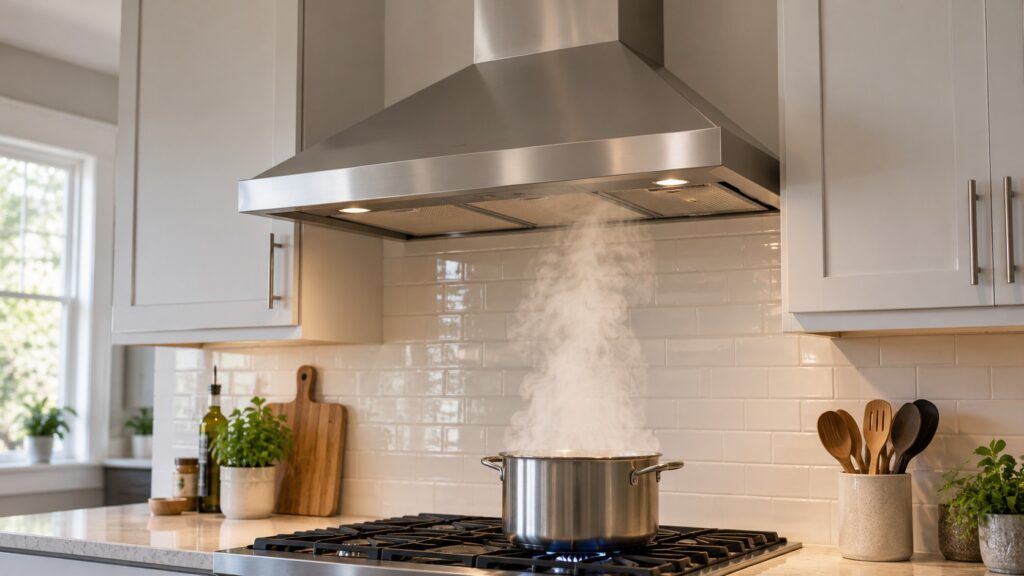
No. Our site lists several Bosch hoods, including island, wall and under-cabinet styles, and the model pages for the HUI80553UC, the HUI54551UC and the HCP86641UC mention a heat sensor, while the other Bosch hood pages on our site do not name one. Do not assume the feature exists because a different hood looks similar. Open the model page or the owner’s manual for your exact model number and look for the words heat sensor or automatic fan control. Our guide to choosing a Bosch vent hood explains the differences between hood styles, and the range hood glossary defines the terms you will see in specifications, such as CFM and sones.
What can you do to help the sensor and the hood work well?
An automatic fan is only as good as the airflow behind it. Keep the filters clean, because a grease-clogged filter reduces the air the fan can move at any speed. Our vent hood filter guide covers the filters. Turn the hood on before you start cooking, not after the kitchen has filled with smoke, and let the delayed shut-off finish rather than switching the hood off at the wall. If you cook with a large pot of boiling liquid, expect steam to be handled by the fan whether or not the sensor reacts, since a sensor responds to heat and not specifically to moisture.
Wipe the hood’s outer surfaces with a soft cloth and mild soap, keeping liquid away from the touch display. Do not spray cleaner into the hood or at the sensor area. If you are unsure where the sensor is, the manual shows it; do not poke at it or remove parts to look for it.
What if the fan speeds up or slows down unexpectedly?
If the fan seems to speed up on its own, remember that this is what a heat sensor is designed to do when the cooktop is hot. Cooking at high heat, a hot oven vent near the hood or a pan left on a burner can all be enough. If the fan runs when the cooktop is cold, will not turn off or ignores your settings, that is a different situation, and our guide on the range hood noise can help you tell a noisy hood from a faulty one. A hood that will not run at all is a separate fault from a fan that changes speed.
For a grease fire in a pan, cover the pan with a lid, turn off the heat, do not turn the hood on and never pour water on it. If you ever smell burning from the hood, see smoke or sparks, or find water near the hood’s electrical parts, switch off the hood’s breaker at the panel while standing on a dry floor and call a technician.
When should you call a technician?
Call if the fan does not respond at all, if it keeps changing speed with a cold cooktop, if the display shows a code that comes back after the power reset described in the owner’s manual, or if the hood is loud in a way it was not before. A hood has a motor, wiring and a control board behind its cover, and the sensor is part of that system, so do not open the hood body or touch the wiring yourself. A technician can test the sensor and the board with the proper tools.
We are an independent repair company, not Bosch. See our Bosch vent hood repair page for how a visit works, or schedule a visit online.