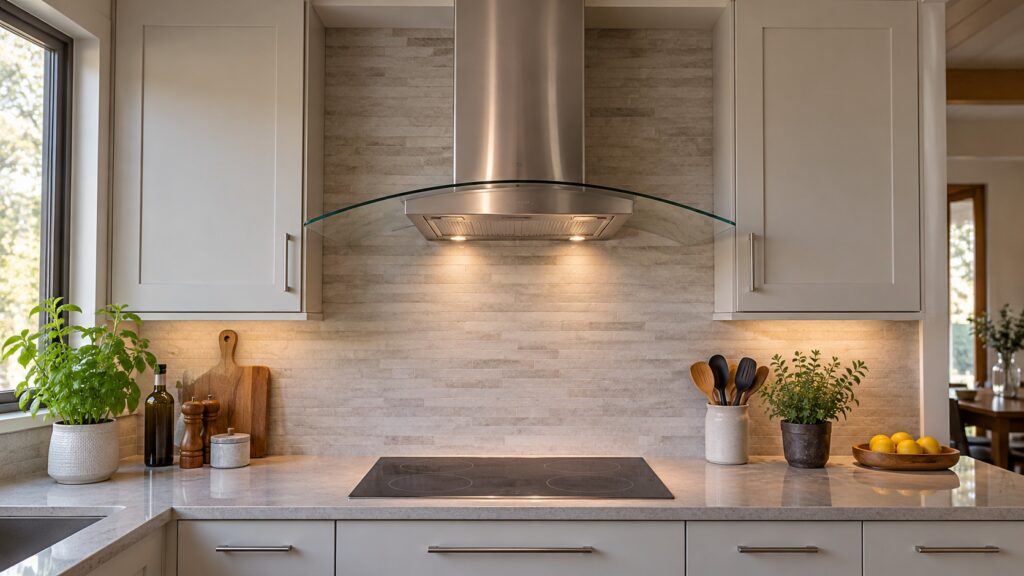
A Bosch range hood glossary comes down to a short list of terms: CFM is how much air the blower moves, sones is how loud it is, perimeter aspiration is how the hood grabs smoke, and the heat sensor, boost mode and delayed shut-off are the automatic behaviors that run the fan for you. Once you can read those words on a spec sheet, comparing a 300 series hood with an 800 series or Benchmark hood stops being guesswork.
What does CFM mean on a Bosch range hood?
CFM stands for cubic feet per minute and tells you how much air the blower can move at its top speed. Bosch hoods in our model list range from 280 CFM on the 300 series under-cabinet models such as the DUH36152UC to 600 CFM on the 500 series and 800 series chimney and island hoods such as the HCP86641UC and HUI80553UC. More CFM captures more smoke and steam, but only if the duct behind it can carry that air outside. A big blower on a narrow, long or many-elbow duct will never reach its rated number.
As a rule of thumb, a high-output gas cooktop or a cooktop used for frequent searing needs a stronger hood than an induction cooktop used mostly for boiling and simmering. Our guide to choosing a Bosch vent hood turns that rule into a decision, and the Bosch range hood ducted vs ductless guide explains how the duct and the blower work together.
What are sones and why do Bosch hoods list two numbers?
Sones measure how loud a fan sounds to a person standing in the room. One sone is roughly the hum of a quiet refrigerator, and the scale is not linear: eight sones is far louder than twice the noise of four. Several Bosch 800 series hoods, including the HCP80641UC and HCP86641UC, list about 1.0 sones at the lowest speed and 8.0 sones in boost. That gap is the whole story of living with a powerful hood: it can be nearly silent for everyday cooking and decidedly loud when you ask for everything it has.
If a hood seems louder than its rating, the problem is usually installation or dirt, not the blower. A loose duct, a damper that flutters or filters packed with grease all add noise. Our Bosch range hood noise troubleshooting guide goes through what to check.
What is perimeter aspiration on a Bosch hood?
Perimeter aspiration is a canopy design in which air enters through a slot around the edge of the hood rather than through a single filter in the middle. The idea is that smoke and steam rising off the cooktop are pulled toward the edges and held under the canopy, so more of the cooking vapor is captured at a given fan speed. Our model list shows it on the island hoods DPH36652UC and HUI80553UC and on the Benchmark island hood HUI54551UC.
It is worth knowing that no canopy design replaces correct sizing. A hood should be at least as wide as the cooktop beneath it and mounted at the height the installation instructions give. A hood that is too narrow or hung too high lets vapor escape around it, whatever the marketing term says.
How do the heat sensor, delayed shut-off and boost work together?
Three automatic behaviors do most of the work on the higher-tier hoods. The heat sensor, listed on models such as the HCP86641UC and the HUI80553UC, watches the temperature above the cooktop and raises the fan speed by itself when cooking gets hot, so you do not have to reach for the control. Delayed shut-off keeps the blower running after you finish, which clears the steam and cooking smell that linger in the minutes after the burners go off. Boost is the manual override, the highest speed, for short bursts such as searing or boiling a large pot.
A sensible routine is to let the hood run in low or automatic mode while you cook, use boost only for the short peak, and leave delayed shut-off on. The result is clean air without living with the loudest setting for long.
What do the control and filter terms on the spec sheet mean?
- LCD touch display. A touch panel on 800 series and Benchmark hoods that shows speed, timer and light settings.
- Push button and rocker switch. Simpler controls on 300 series and 500 series hoods, with fewer parts to fail.
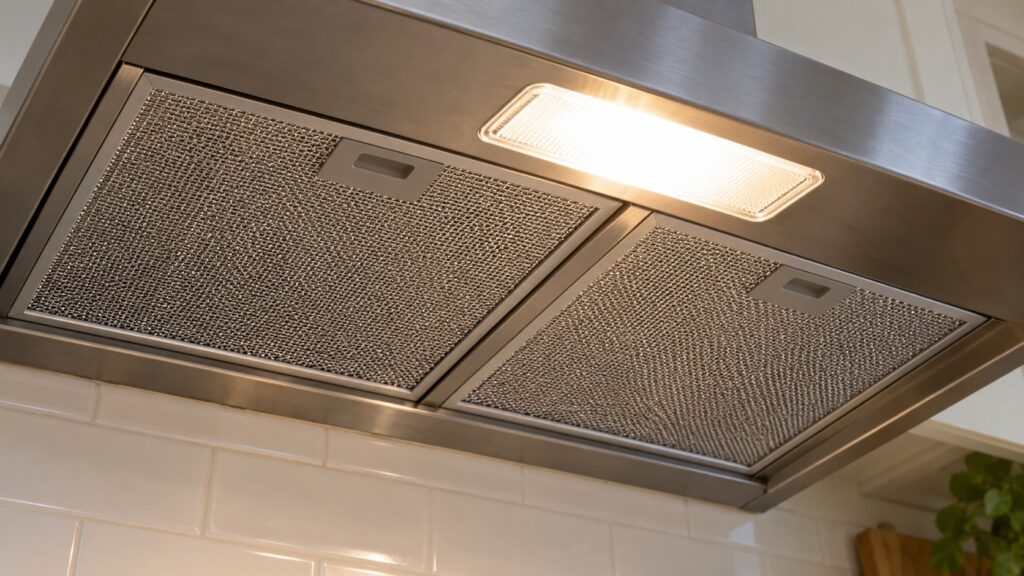
- Mesh filter. A washable metal filter that traps grease; our model list marks the Bosch mesh filters dishwasher-safe.
- Chimney extension. The adjustable upper stack that lets a wall or island hood fit ceilings of different heights.
- Island and wall mount. Island hoods hang from the ceiling over a cooktop in a kitchen island; wall hoods mount to the wall behind the range.
Washable mesh filters only help if you wash them. Follow the steps in our Bosch vent hood filter replacement guide at least every month or two if you cook with oil regularly.
Which terms matter most when comparing a 300, 500 and 800 series hood?
For most kitchens, three terms decide the purchase. Match the CFM to your cooktop, read the sones at the speed you will actually use, and decide whether automatic features such as the heat sensor are worth the added controls. The rest, from glass canopies to LED lights, are style. If your hood is already installed and has stopped working as described on its spec sheet, our Bosch vent hood repair page explains what a visit covers.