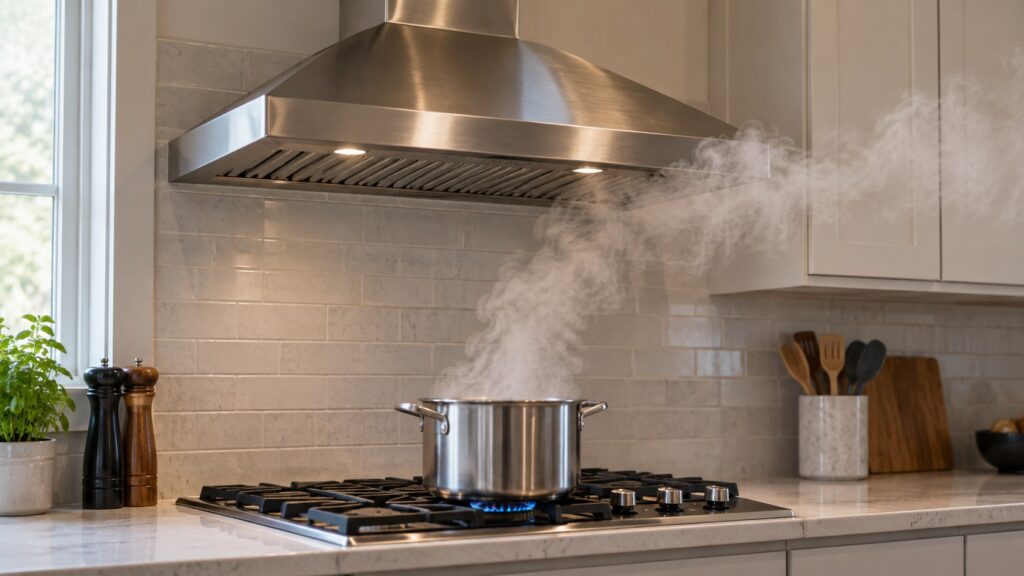
If a Bosch range hood fan not working is what you are searching for, the appliance is called a range hood or vent hood in the US, and a fan that will not start usually comes down to a short list of causes: the wrong control or a lock on the panel, a grease-laden fan that is too heavy to spin, a failed fan motor or capacitor, or a control board that is not talking to the panel. Our site lists error code E1 for a fan motor that is not running or not reaching its speed. The first checks are simple and safe; the rest belong to a technician.
Why is my Bosch range hood fan not working?
Start by deciding which of three situations you are in. In the first, the fan does nothing but the light still works. That points to the fan motor, its capacitor or the part that commands them. In the second, nothing works, not even the light, which points to the power supply or the control electronics. In the third, the hood runs but seems weak, which is usually a filter or duct matter and not a dead fan.
Our E1 page lists the symptoms of a fan motor fault: the hood does not turn on when a speed is selected, the motor hums but the fan does not spin, the fan starts briefly then stops, or suction is reduced even at high speed. It names a failed motor capacitor, a motor winding failure, a seized bearing and a grease-laden fan blade as the common causes. Those are the things a technician checks.
What can you check safely from below?
Keep to what you can do with the hood in place and your feet on the floor. Make sure you are pressing the right control. Bosch hoods on our site use push buttons, rocker switches or LCD touch displays, depending on the model, and the touch types can ignore a damp or greasy finger. Wipe the panel with a barely damp cloth and try again.
Check the light. If the light works and the fan does not, the hood has power. If neither works, look at the breaker for the kitchen circuit, and if it keeps tripping, stop and call a technician instead of resetting it again.
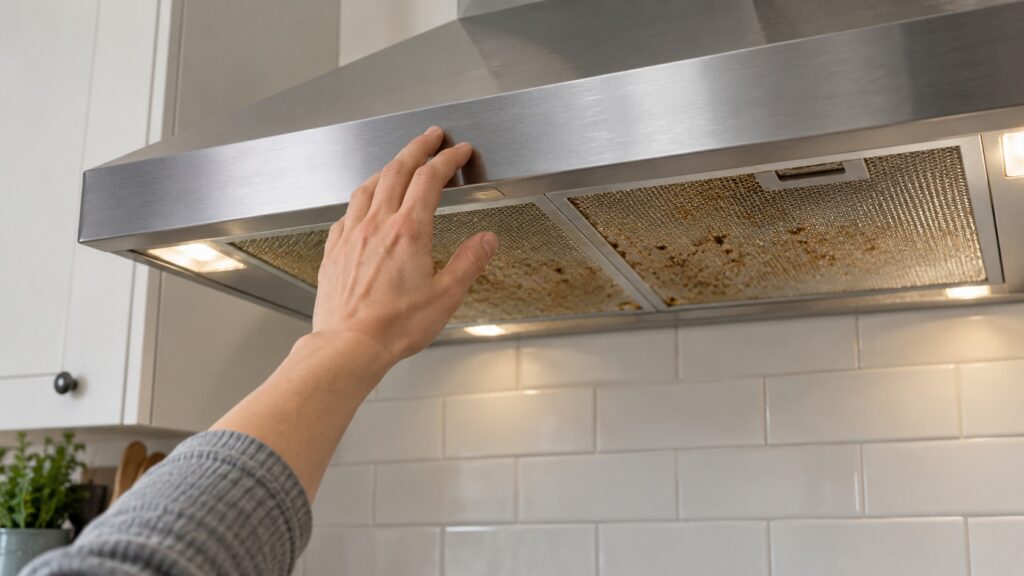
Look at the grease filters. Our vent hood filter guide says the metal mesh grease filters need cleaning, not replacing, and that most are dishwasher-safe. Take them out, clean them and put them back until they click in. A hood that has been neglected for a long time can be sluggish, and clean filters rule that out.
What are the signs that the fan is fine after all?
Some hoods behave in ways that look like faults. Our model pages for several island and wall hoods describe delayed shut-off, which keeps the fan running after cooking to clear residual steam. Others, such as the HUI80553UC, HCP86641UC and HUI54551UC, list a heat sensor that raises the fan speed automatically when it detects rising temperature above the cooktop. A hood that starts on its own or keeps running after you switch it off may simply be doing what it was built to do. The model’s manual explains the behavior.
E4 is another false alarm. Our E4 page calls it a maintenance reminder rather than a problem: the hood still functions, but the grease filter needs cleaning or replacing. See the E4 page.
What do E1 and E3 mean on a Bosch hood?
E1 is listed on our E1 page as a fan motor failure, where the motor is not responding or is running at the wrong speed. E3 is listed on our E3 page as a communication error in the control system, between the touch panel and the control board or inside the board. Its symptoms include a panel that does not respond, fan speeds that cannot be changed and, in some cases, a hood that is not working at all. Codes differ by model generation, so check your manual for the exact meaning.
Both are marked as needing a technician if simple cleaning does not help. A technician checks the capacitor first, because it is the cheaper part, before condemning the motor.
What should you not do?
Do not take off the filter assembly or the bottom cover to reach the motor. Our E1 page describes how a technician gets to the motor, but a hood sits above a hot cooktop with mains wiring inside the canopy, so this is not an owner’s job. Do not climb onto the range to inspect the blower, and do not spray cleaner into the housing.
Also do not cook heavily without a working hood. If the fan is out, use lower heat, open a window and avoid frying or searing until it is fixed. If grease catches fire in a pan, cover the pan with a lid, turn off the heat, do not pour water on it and do not turn on the hood. If you smell burning from the hood itself or see smoke, switch off the breaker for the hood at the panel while standing on a dry floor and call a technician.
Is the fault in the hood or in the duct?
A weak or noisy hood is not always a dead fan. Our range hood noise guide notes that clogged filters, loose ductwork and a damaged backdraft damper at the outside wall can change how a hood sounds and performs. Our range hood venting guide explains the duct side. If your hood runs but moves little air, check that the damper outside opens when the fan runs. If it does not, tell the technician.
When should you call a technician?
Call if the fan will not start after you have cleaned the filters and tried the right control, if you see E1 or E3, if the hood hums but does not spin or if it trips a breaker. We are an independent repair company, not the manufacturer. A Bosch vent hood repair visit starts with a diagnosis, and we confirm the estimate before any work begins. A motor or capacitor swap is usually far cheaper than a new hood, but an old hood with several problems is worth a second thought.