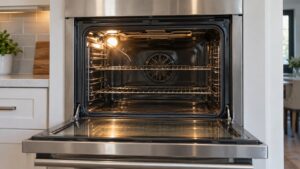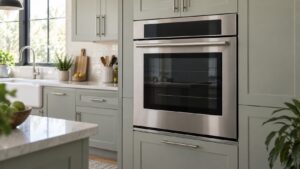
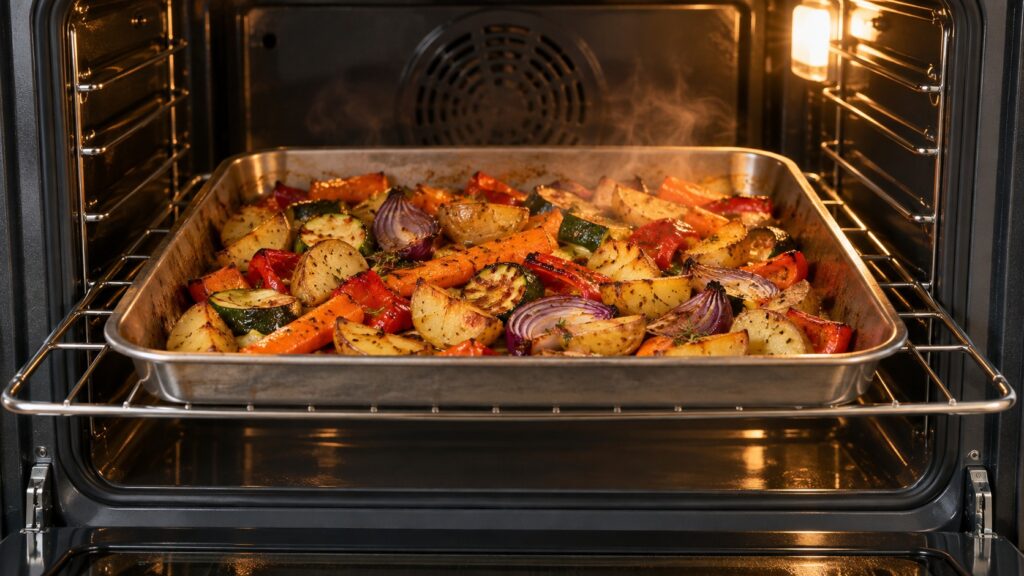
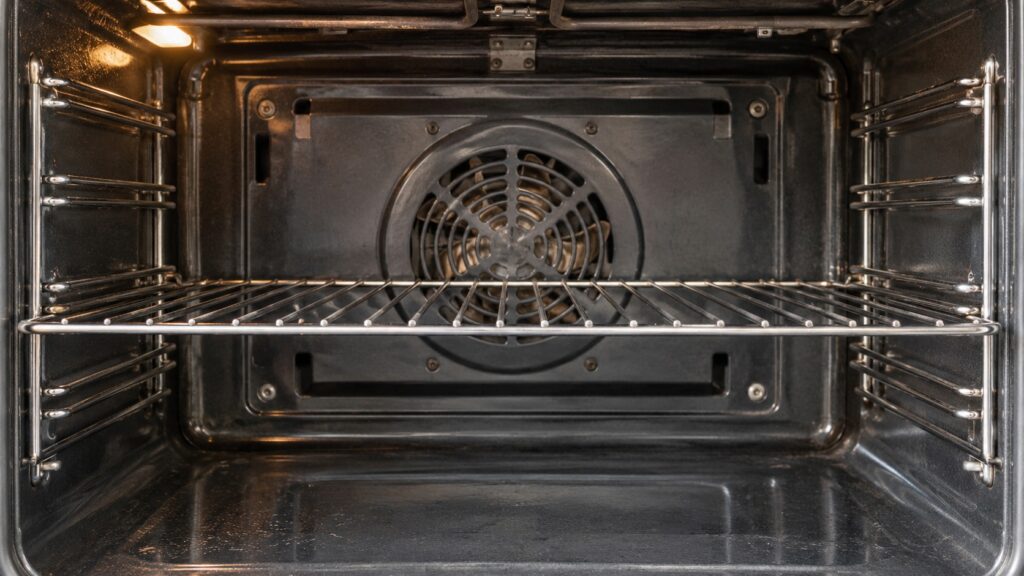
A Bosch convection oven cooks with a fan that moves heated air around the food, so heat reaches every surface at the same time. On most Bosch models the fan sits at the back of the cavity and works with a heating element placed around it, which is why convection modes brown faster and more evenly than a plain bake setting, and why many recipes can be cooked at a slightly lower temperature or for a shorter time.
How does a Bosch convection oven work?
In a standard bake mode, heat comes from elements at the top and bottom of the cavity, and the air inside barely moves. That leaves hot and cool pockets, which is why the back of a pan can cook faster than the front, or the top rack can brown more than the bottom. Convection solves this by adding airflow. A fan pulls air across the heat source, pushes it through the cavity, and keeps it moving so that the temperature around the food evens out.
Bosch ovens that use a heating element wrapped around the fan heat the air right at the source, which is the arrangement people describe as European convection. The advantage is heat that is both fresh and well mixed, and a cavity that recovers quickly when you open the door. The control board reads a temperature sensor in the cavity and switches the element and fan to hold the target, so the oven corrects itself during the cook.
What happens to the fan and the element during a cook?
When you select a convection mode, the board starts the fan and powers the element to bring the cavity to temperature. The fan then runs for as long as the mode is active, and the element cycles on and off to hold the set point. You will hear a fan hum and may notice that the oven reaches temperature sooner than in a plain bake mode, since the moving air spreads the heat quickly.
The fan can keep running after you switch the oven off, because it cools the electronics and the cavity. That is normal behavior, not a fault. If the fan keeps going for a very long time or never stops, our guide on a Bosch oven fan that runs continuously explains when it is normal and when it needs attention.
How should you change recipes for convection?
Recipes are usually written for a conventional oven, and moving air cooks food faster. A common rule is to lower the temperature by about 25 degrees Fahrenheit, or to shorten the time by roughly a fifth, then check early. Foods with a lot of surface, such as roast vegetables, chicken pieces and cookies, benefit the most, because the airflow dries the surface and encourages browning.
Use low-sided pans and sheets for roasting so the air can reach the food, and avoid covering everything with foil, which blocks the airflow you are paying for. Leave space between pans on multiple racks so the air can move around each one. For delicate cakes, custards and bread dough that must rise undisturbed, a plain bake mode is often the better choice, because the fan can dry the surface or push a thin batter to one side.
When is convection not the right mode?
Convection is not always better. Soufflés and light sponge cakes can dry or lean in a draft of hot air. Foods covered in a loose batter, such as some quick breads, can set on top before the middle has risen. Long, slow braises in a covered pot gain very little, since the lid already keeps the air away from the food.
Think of convection as the choice for crisp, brown, dry-surface cooking, and conventional bake as the choice for gentle, even rising. Many cooks use both in a single meal, roasting the main course with the fan on, then switching to bake for the dessert. Our Bosch oven hidden features guide covers other modes that are easy to miss on the dial or touch panel.
How do you tell if the convection system is not working?
There are a few clear signs. If you select a convection mode and never hear the fan, or you hear a grinding, rattling or squealing noise from the back, the fan motor or its blade may need attention. If food cooks unevenly in a mode that normally gives even results, the fan may not be turning or the element around it may be weak. If the oven seems to run cooler or hotter than the display says, the temperature sensor may be out of range.
Start with simple checks. Make sure nothing is blocking the rear fan cover, such as a pan pushed against it, and that the racks are seated correctly. A temperature test with an oven thermometer can show whether the oven is off, and our guide to calibrating your Bosch oven temperature explains the adjustment you can make from the settings menu. For heating faults, see Bosch oven heating problems.
When does a convection fault need a technician?
Call a technician when the fan will not turn, makes a loud noise that does not stop, or the oven fails to heat in convection modes only. Those point to the fan motor, the element around it or the control board, and they involve parts inside the cavity wall and electrical connections that should not be opened by a homeowner. Switch the oven off at the breaker before anyone works near it.
If your oven is old and several parts are failing together, the question becomes whether to fix it or move on. Our Bosch oven repair or replace guide sets out the factors, and the Bosch oven repair page explains how a visit is arranged.