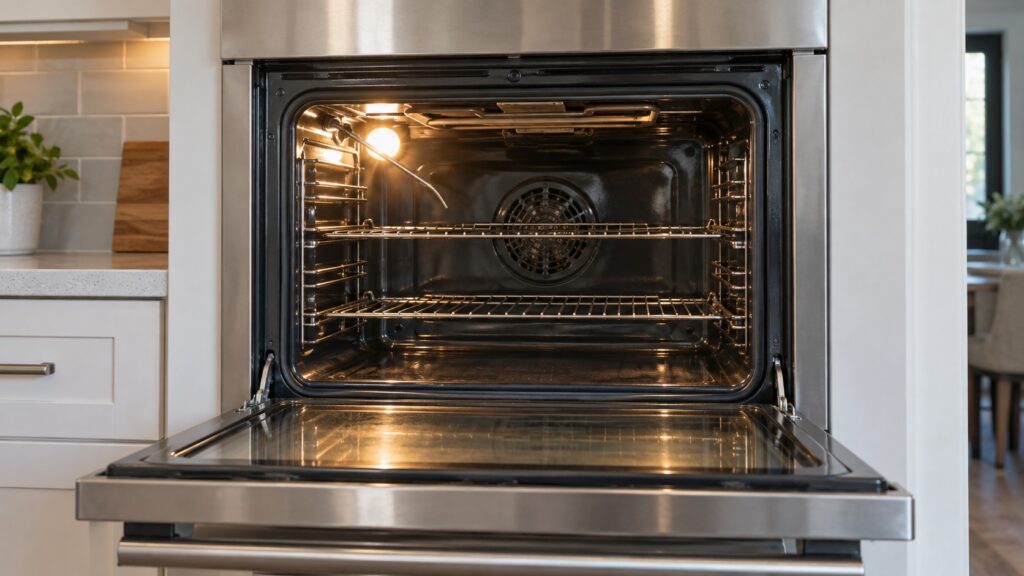
A Bosch oven E011 is an open circuit in the oven temperature sensor. The control board sends a small current through the sensor in the top corner of the cavity, expects a resistance it recognizes, and gets nothing back — so it shuts the heat off rather than run an oven it cannot measure. The sensor itself, its two-wire plug at the back of the cavity, or the harness between them is where the fault lives, and on a wall oven that is a repair, not a setting.
The first thing worth knowing is that the number is not universal, even inside this site. E011 on a Bosch wall oven and E011 on a Bosch range are two different faults on two different systems.
What does E011 mean on a Bosch oven?
The sensor is a resistance thermometer, not a thermostat. It has no contacts and no switching of its own: its resistance rises predictably as the cavity heats, and the board reads that resistance several times a second to decide whether to call for more heat. An open circuit means the loop is broken somewhere — a burned-through sensor element, a plug that has backed out of its socket, or a wire that has chafed through against the cavity liner where it runs behind the back panel.
Because the reading is missing rather than wrong, the oven’s response is absolute. It does not run hot or cold; it refuses to heat at all, usually after a few seconds of preheat, and it holds the code until the power is cycled. If your Bosch oven E011 clears on a power cycle and comes straight back on the next preheat, the break is real and permanent. If it comes back only sometimes, you are chasing a connection rather than a dead sensor. We keep a page for the code itself at Bosch oven error code E011, and the underlying part is explained in our NTC sensor glossary entry.
Why does the same code mean something different on a Bosch range?
Bosch numbers faults by the board that raises them, not by the appliance you bought. A built-in wall oven has one board handling one cavity, so its low numbers belong to that cavity’s sensing. A freestanding or slide-in range has a cooktop above the same cavity, and its board starts its numbering with the surface burners — so E011 there is an ignition failure, a burner that clicked and did not catch.
This is the single most common way people waste an evening on a Bosch oven E011. They search the code, find an ignition answer written for a range, and go looking for a spark module on an electric wall oven that does not have one. Read the code against the appliance in front of you. If you have a gas range and a burner that will not light, the guide you want is Bosch range burner not igniting, and the code page is E011 under the range, not under the oven.
How do you check the oven temperature sensor yourself?
Stop at the power first. The sensor plug sits behind the back panel of the oven or behind the rear wall of the cavity, both of which put your hands within inches of mains terminals and, on a wall oven, above head height in a cabinet. Pull the breaker, not just the control knob, and confirm the oven is dead before anything comes off.
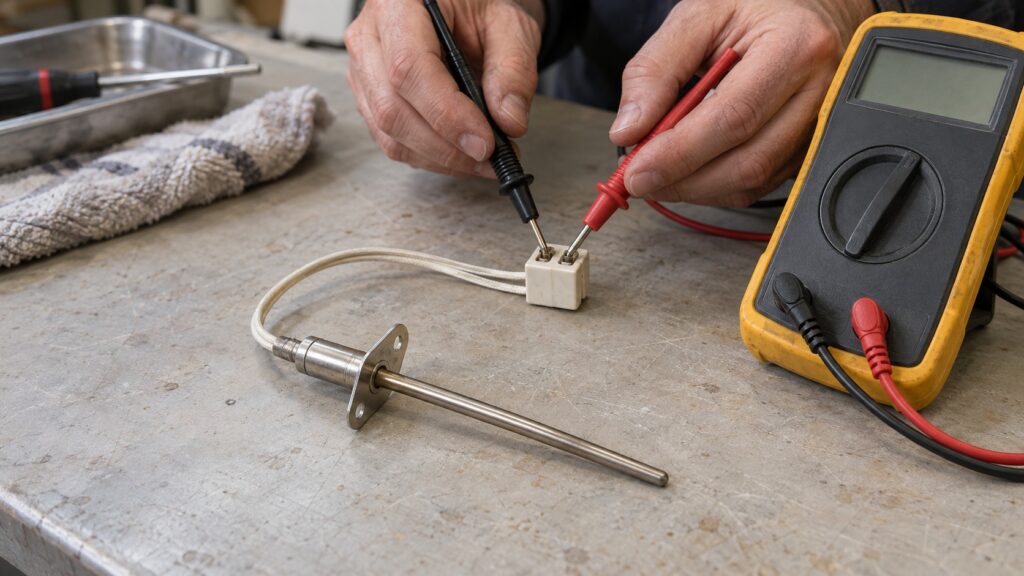
- Look in the cavity. The sensor is the thin metal probe in an upper corner, held by two screws through a small plate. A probe that is bent, melted at the tip, or coated in carbonized spill has usually failed.
- Check the plug. Most Bosch ovens bring the sensor’s two wires to a ceramic connector just behind the cavity wall. Heat cycling works those plugs loose over years, and a plug that has walked halfway out reads as an open circuit.
- Measure the resistance. A cold sensor should read a stable value in the neighborhood of 1,000 ohms — check the figure on your model’s service sheet, because the exact target varies by series. An open reading confirms the sensor. A sensible reading at the sensor but an open one at the board points at the harness in between.
- Wiggle while you measure. A reading that jumps as you move the harness is the chafed wire, and replacing the sensor alone will not fix it.
What else trips this code besides a failed sensor?
Three things account for most of the rest. The first is a self-clean cycle: pyrolytic temperatures are hard on the sensor and harder on the plug, and a code that first appeared the day after a clean is usually a heat-stressed connection rather than a coincidence. The second is an oven that was pulled out for other work — a slide-in swapped for a repair, a wall oven lifted for cabinet refacing — where the harness was pinched on the way back in. The third is water: a spill through the vent slots, or a steam oven that has not been descaled, can corrode the plug contacts until the circuit reads open intermittently.
None of those are calibration problems, which is worth saying because the codes look related. If your oven heats but runs off temperature, you want our calibration guide instead; calibration cannot fix a sensor the board cannot read at all. If the oven heats unevenly or not at all without a code, start with Bosch oven heating problems.
Can you keep using the oven while the code is showing?
The oven will not let you, and that is deliberate. With no temperature reading, the board has no way to stop the elements, so the safe response is to refuse the cycle. On a double oven, the second cavity has its own sensor and usually keeps working, which buys you time but does not change the repair. On a range, the cooktop is on a separate circuit from the oven cavity and stays usable.
What you should not do is bypass the sensor with a resistor to “get through the holiday.” An oven heating on a fixed fake reading has no upper limit, and the overheat protection that would normally catch it is watching a different number entirely.
When should you hand this one to a technician?
A sensor swap is a genuine do-it-yourself job on a range you can pull forward and an honest half-day job on a wall oven built into a tall cabinet, where the unit has to come out of the opening before the back panel is reachable. If the measurement points at the harness or at the board rather than the probe, or if the code returns with a new sensor fitted, the fault is upstream and the diagnosis is worth paying for rather than guessing at in parts.
We are an independent repair company, not a factory service arm. Pricing starts from a diagnostic visit and we confirm the estimate before any work begins. Bosch oven repair covers sensors, harnesses, elements and control boards, and you can schedule a visit online or call 1-844-731-6692. If the oven is well into its second decade, read repair or replace before you order a board.