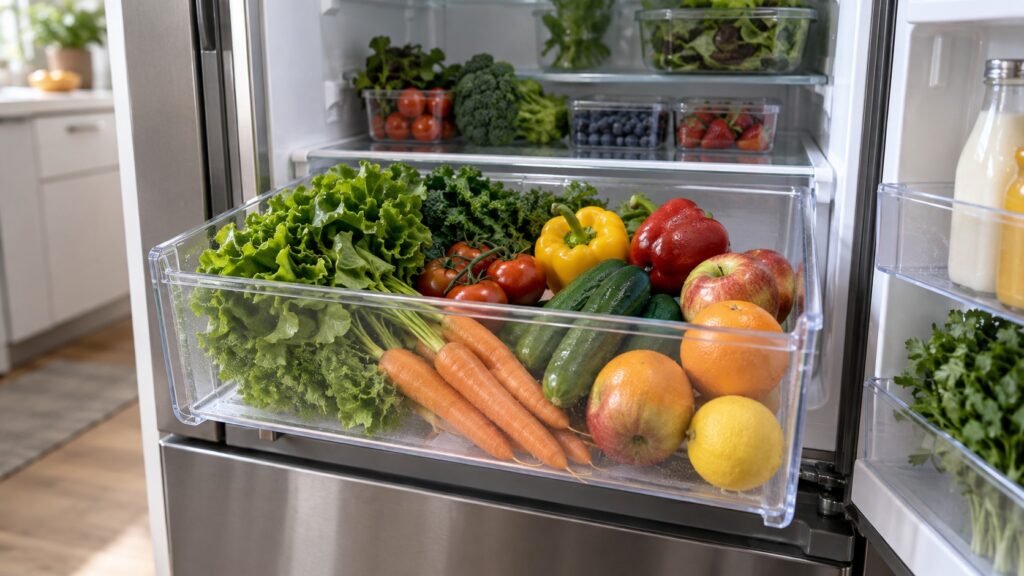
Bosch VitaFreshPro is a humidity-controlled crisper drawer system that lets a refrigerator hold two different moisture levels for two different kinds of produce, instead of forcing fruits and vegetables to share one compartment set to a single compromise setting. Understanding how the mechanism works explains why the same drawer can extend a bag of spinach’s life in one setting and dry out a bowl of berries in that same setting.
What is Bosch VitaFreshPro?
VitaFreshPro is Bosch’s name for a crisper drawer system that separates fresh produce storage from the rest of the refrigerator and gives it its own adjustable humidity control. Rather than one crisper drawer at one fixed humidity, VitaFreshPro drawers typically offer at least two settings, letting a household store fruit at a drier setting in one drawer and leafy vegetables at a moister setting in another, side by side in the same refrigerator.
The system exists because a standard refrigerator compartment is a poor storage environment for most fresh produce on its own — the air is too dry for leafy greens, which wilt quickly, and any moisture that does build up around fruit accelerates spoilage. A dedicated, adjustable drawer solves both problems by letting the household choose which environment a given drawer provides.
How does the humidity control mechanism actually work?
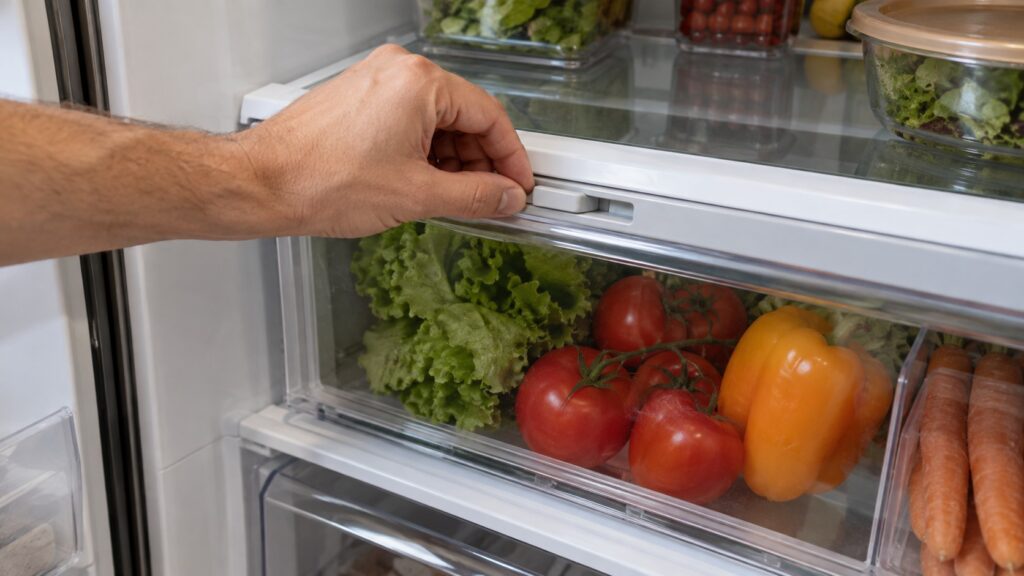
The core of the system is a small slider or damper on the front or side of the drawer that opens or closes a vent. Closing the vent traps more of the moisture that naturally comes off produce as it sits, raising the humidity inside that drawer. Opening the vent lets that moist air exchange with the drier air of the main refrigerator compartment, lowering the humidity inside the drawer. It is a mechanical adjustment, not an electronic sensor and motor — moving the slider changes the size of the opening, and the drawer settles into a new humidity level over the following hours rather than instantly.
Because the change is gradual, it helps to set the humidity level when the drawer is loaded rather than adjusting it repeatedly afterward expecting an immediate result. A slider left in one position for weeks does its job quietly; one moved back and forth daily never lets either extreme fully establish itself.
Why do fruits and vegetables need different humidity settings?
Leafy vegetables and herbs are made mostly of water held in soft cell structures with a lot of exposed surface area, and that water evaporates readily into dry air — which is why spinach and lettuce wilt within a day in a low-humidity drawer. A high-humidity setting slows that evaporation by keeping the air around the vegetables closer to saturated, so the produce loses water more slowly.
Most fruit behaves differently. Many fruits continue to ripen after harvest by releasing ethylene gas, and that ripening process, combined with trapped moisture, speeds up decay rather than slowing it. A low-humidity setting lets that ethylene and excess moisture disperse instead of concentrating around the fruit, which is why the same humidity level that helps lettuce actively works against berries or apples stored in it.
How should you actually use the two settings?
Sort produce by category before deciding which drawer it goes in, rather than by what happened to be in the shopping bag together. Leafy greens, fresh herbs, broccoli and celery generally do better on the high-humidity setting. Apples, pears, stone fruit and berries generally do better on the low-humidity setting, ideally away from vegetables that are still emitting their own ethylene.
- High humidity: lettuce, spinach, kale, herbs, celery, broccoli.
- Low humidity: apples, pears, berries, grapes, stone fruit.
- Either, with judgment: peppers and cucumbers tolerate both settings reasonably well.
Our refrigerator organization tips guide goes further into which shelf and drawer suits which food category across the whole refrigerator, not just the crisper drawers.
Does the main refrigerator temperature setting affect the crisper drawers?
Yes, and it is worth understanding the relationship between the two. VitaFreshPro’s humidity control adjusts moisture within the drawer, but the drawer still sits inside the same fresh-food compartment as the rest of the refrigerator, and it still cools to roughly the same overall temperature range as everything above it. Humidity and temperature are separate variables — the slider changes one, the thermostat changes the other — and both matter for produce life. A crisper drawer set to the correct humidity but sitting in a compartment running several degrees too warm will still underperform, because the temperature side of storage is being handled elsewhere in the refrigerator.
This is also why a crisper drawer near the back of the compartment, closer to the cold air outlet, sometimes behaves slightly differently from one near the front, even with the same humidity setting. If produce in one drawer consistently performs better than an identically set drawer elsewhere in the same refrigerator, that positional difference is a more likely explanation than the humidity mechanism itself being at fault.
What if VitaFreshPro does not seem to be working?
If produce is wilting or spoiling faster than expected despite the correct setting, the humidity slider is not usually the first thing to suspect. Check the drawer seal and make sure it is closing fully, since a gap lets the drawer’s controlled atmosphere leak away regardless of where the slider sits. Also check that the drawer is not overpacked to the point the vent is physically blocked by produce pressed against it. If the whole refrigerator is running warm rather than just one drawer, that points toward a broader cooling problem rather than the humidity feature — see our refrigerator not cooling guide before assuming the crisper drawer itself is at fault.
We are an independent repair company, not a factory service arm. Bosch refrigerator repair covers crisper drawer seals, dampers and the cooling system behind them, and you can schedule a visit if produce keeps spoiling despite the right settings. Our AquaSensor how-it-works guide is a related read if you want to understand another of the refrigerator’s built-in sensing systems.