An ice maker is the part of a refrigerator most likely to be neglected and most likely to be blamed. It is a small water circuit with a heater, a motor and a valve, tucked inside a freezer where nobody looks. Bosch ice maker maintenance is mostly about water quality and airflow, and doing it on a schedule prevents the two complaints we hear most: ice that tastes wrong, and ice that stops arriving.
The filter is the whole story on taste
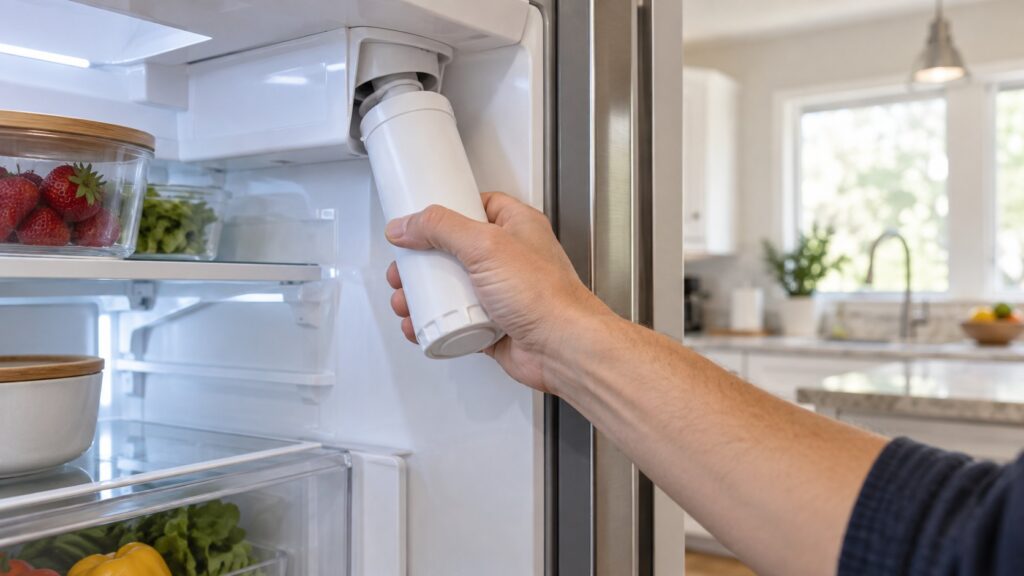
Almost every complaint about ice tasting or smelling wrong resolves to the water filter, and almost every one of those filters was changed late. A filter does not fail suddenly; it saturates gradually, and by the time the taste is noticeable it has been passing untreated water for weeks. Change it every six months regardless of how the water tastes, and note the date somewhere you will find it.
After changing one, flush several gallons through the dispenser before trusting the ice. New filters shed carbon fines on first use, which is harmless and looks alarming — gray-flecked first cubes are the filter bedding in, not a fault. Discard the first two batches of ice as well.
Ice absorbs everything around it
Frozen water is porous and it is in an enclosed space with whatever else is in the freezer. An unwrapped package, an open box of anything aromatic, or a freezer that has not been cleaned in a year will all end up in the ice. The bin itself is the worst offender because it sits open by design.
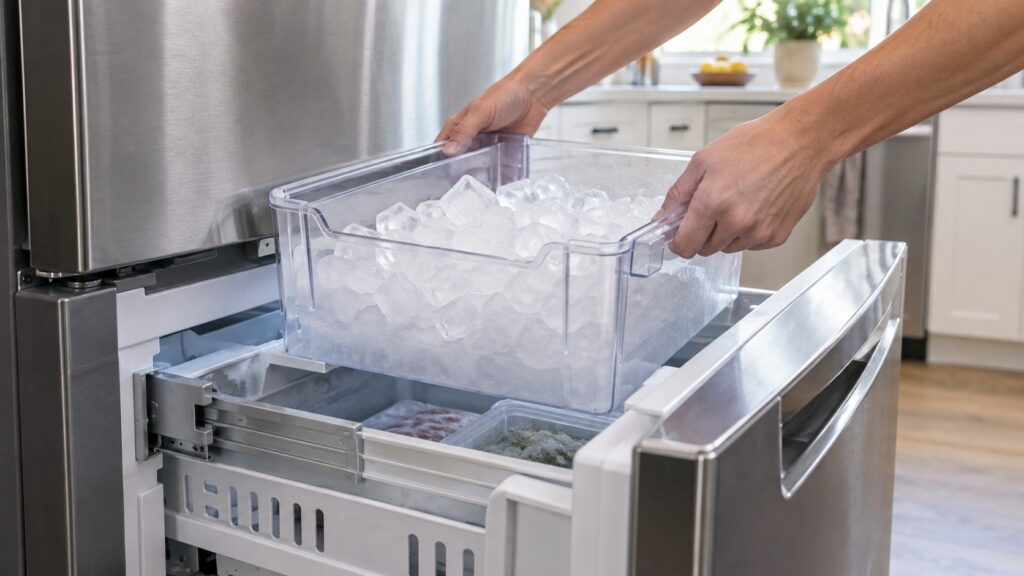
- Empty and wash the bin every three months in warm water. No detergent, no scented cleaner — the plastic holds the scent and passes it straight to the ice.
- Dry it completely before refitting. A damp bin freezes its next batch into a block.
- Wrap everything else in the freezer properly. This is as much an ice-quality measure as a food one.
- Do not store food in the ice bin. It happens more than you would think, and the bin never smells the same again.
Why ice stops arriving
Production problems fall into three groups and they are easy to separate. If there is no ice at all and no water in the mold, the supply is not reaching the machine: a closed valve, a kinked line, a frozen supply tube, or a filter so blocked that flow has collapsed. If the mold fills but never ejects, the harvest mechanism or its heater is the issue. If ice forms but arrives slowly, the freezer is not cold enough or the airflow around the ice maker is blocked.
That last one is common and entirely self-inflicted: a freezer packed to the roof stops air circulating past the ice maker, and the machine runs a long harvest cycle on every batch. Leave the vents clear. Our page on refrigerator error codes covers what a display is reporting, and the annual maintenance guide covers the rest of the appliance.
The cubes tell you what is wrong
Small or hollow cubes mean the mold is not filling completely — low water pressure, a partly blocked filter, or a valve that is not opening fully. Cloudy cubes are dissolved air and minerals and are cosmetic. Cubes fused into a single block mean the bin has partially melted and refrozen, which points at a door left ajar, a failing door seal, or a freezer running too warm.
A block in the bin is worth taking seriously rather than breaking up and forgetting, because it is telling you the freezer warmed up at some point. Check the door seal with a strip of paper before assuming the ice maker is at fault.
Production rate, and what is actually normal
People frequently ask us to look at an ice maker that is working correctly, because the expected rate is higher than the real one. A household ice maker produces a batch at a time and then has to refreeze; a full bin from empty takes the better part of a day, not an hour. A party that empties the bin will outrun it, and that is not a fault.
Two things genuinely slow production and both are worth checking before anything else. A freezer set warmer than it used to be lengthens every harvest cycle — a couple of degrees is enough to be noticeable. And a door opened frequently dumps cold air, so a refrigerator in daily heavy use makes measurably less ice than the same appliance in a quiet kitchen. Neither is a defect; both are worth knowing before paying for a diagnosis.
The supply line behind the appliance
Once a year, pull the refrigerator forward far enough to see the water line. You are looking for three things: a kink from the appliance being pushed back too hard, a damp patch at the connection, and a saddle valve — the pierce-type tap clamped onto a copper pipe — which is a known slow-leak point and is no longer permitted in many jurisdictions for exactly that reason.
A weeping connection behind a refrigerator does its damage invisibly, into a floor that nobody looks at, for months. It is the cheapest inspection in this guide and the one with the largest downside if skipped.
When maintenance is not the answer
A machine that fills and never harvests, one that harvests continuously, one that leaks inside the freezer, or one that has iced over entirely is past the point of routine care. So is an ice maker that stopped when nothing changed. Those are the motor, the heater, the valve or the sensor.
We are an independent repair company, not a factory service arm. Pricing starts from a diagnostic visit and we confirm the estimate before any work begins. Bosch refrigerator repair covers the ice maker and the water circuit, and you can schedule a visit online. For settings rather than upkeep, see our temperature settings guide.