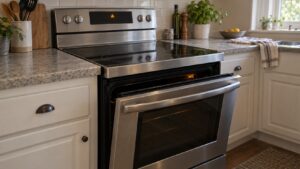
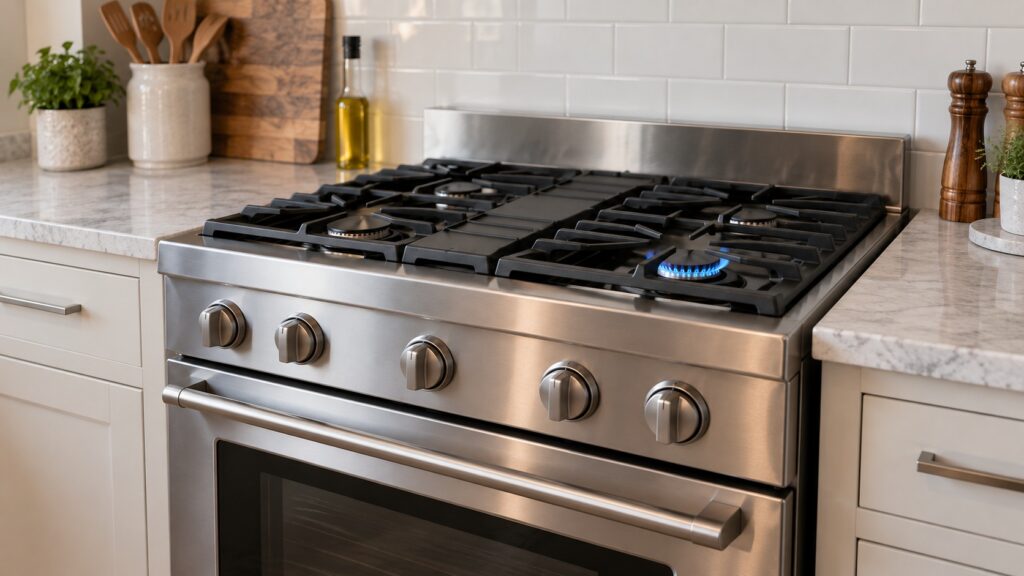
The Bosch range repair or replace decision depends on three things: the age of the range, how many parts are failing and what kind of range it is. A range under about ten years old with one failed part, such as an igniter, a temperature sensor or a bake element, is usually worth repairing. A range with a failing control board plus other faults, or one that is well past a decade, is often better replaced.
How old is too old to repair a Bosch range?
Ranges are built to last a long time. A typical Bosch range commonly gives a decade or more of service, and gas models with simple parts often last longer than induction models with dense electronics. Age is a guide rather than a rule, but it shapes every other part of the decision. Under about eight years, a repair is almost always sensible, because the rest of the range has most of its life ahead. Between eight and twelve years, think carefully about the specific fault. Beyond twelve, a repair that would be routine on a younger range has to be weighed against how likely the next failure is.
Our appliance lifespan guide sets out typical service lives for the major appliances, and it is a good starting point before you decide on a particular range.
Which range faults are worth repairing?
Single-part faults are the best candidates. A gas burner that will not light often needs only a cleaned or replaced igniter, and our guide on a Bosch range burner that will not ignite shows how often that is the whole story. An oven that heats unevenly or not at all may need a bake element, and an oven that reports a temperature sensor problem may need that sensor replaced, since the sensor error described on our Bosch oven E011 guide is a cheap part for the work involved.
Door hinges, knobs, gaskets, lights and a failed oven fan are also routine repairs. What they share is that the cause is clear, the part is available and the rest of the range is sound. When a technician can tell you what failed, what it takes to fix it and why the fix should hold, the repair usually makes sense.
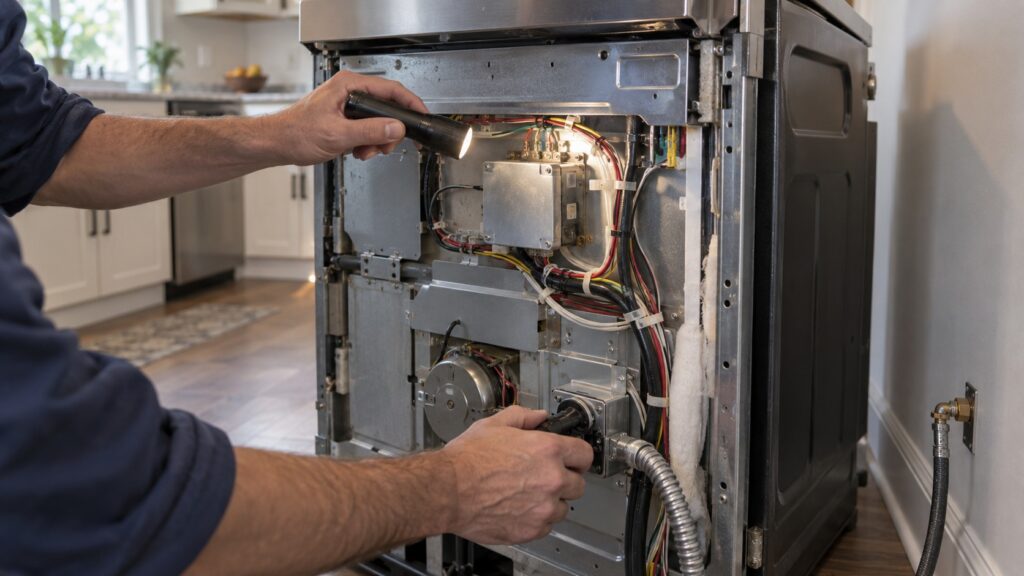
Which faults point toward replacement?
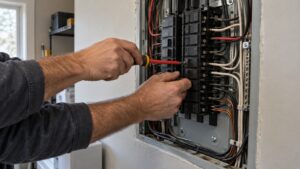
The faults that push you toward replacement are the ones that mean the range’s electronics are failing as a whole. A control board that is dead or intermittent, shown by a communication error such as the one on our Bosch range E305 control board guide, is expensive to replace, and on an older range it may fail again alongside other parts. A cooktop with a cracked glass top is also costly, since the glass is a large single part.
Several unrelated faults at the same time are another warning. If the oven will not heat, a burner has failed and the display flickers, the range is telling you that its components are wearing out together. Fixing one does not stop the next from failing. Add to that anything that suggests safety damage, such as scorched wiring or a swollen, warped control panel, and replacement is the prudent route.
Does the type of Bosch range change the decision?
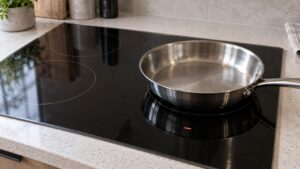
Yes. Gas ranges have fewer electronics and are made of parts that can be replaced one at a time, so repair is the usual answer for gas faults. Electric radiant ranges are similar, with simple elements and switches. Induction ranges are more efficient and respond quickly, but the induction generator and the control boards under the glass are specialized parts. For an induction range, the decision depends heavily on the failing part.
A zone that will not heat on an induction range can be a failed coil or generator, or a simple pan problem. Our Bosch induction zone not heating guide helps separate the two. If the problem is a pan, there is nothing to repair. If it is the generator and the range is old, replacement is worth considering.
What should you ask before approving a repair?
Ask what failed, whether the fault could return, whether the part is in stock, and what the repair involves. Ask whether anything else on the range is showing wear, such as other burners, the door seal or the display. A good diagnostic visit ends with a plain recommendation, including advice not to repair when that is the better answer, rather than a push toward the most expensive option.
Think about your plans too. If you are remodeling in a year or two, a modest repair to keep the range going may be better than buying a new one that does not suit the new kitchen. If the range is the wrong size or fuel type for the space, replacement may be a natural moment to change. Our Bosch oven repair or replace guide covers a similar decision for wall ovens.
What safety signs mean stop using the range?
Stop using a range and call for service immediately if you smell gas, see sparks, find melted wiring or a burn mark, or see an element glowing through a cracked cooktop. Turn off the gas supply for a gas smell, ventilate the room and keep ignition sources away. For electrical signs, switch off the breaker. These situations are not decisions about repair or replace but urgent safety problems, and they come before cost.