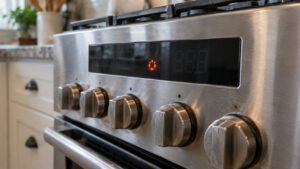
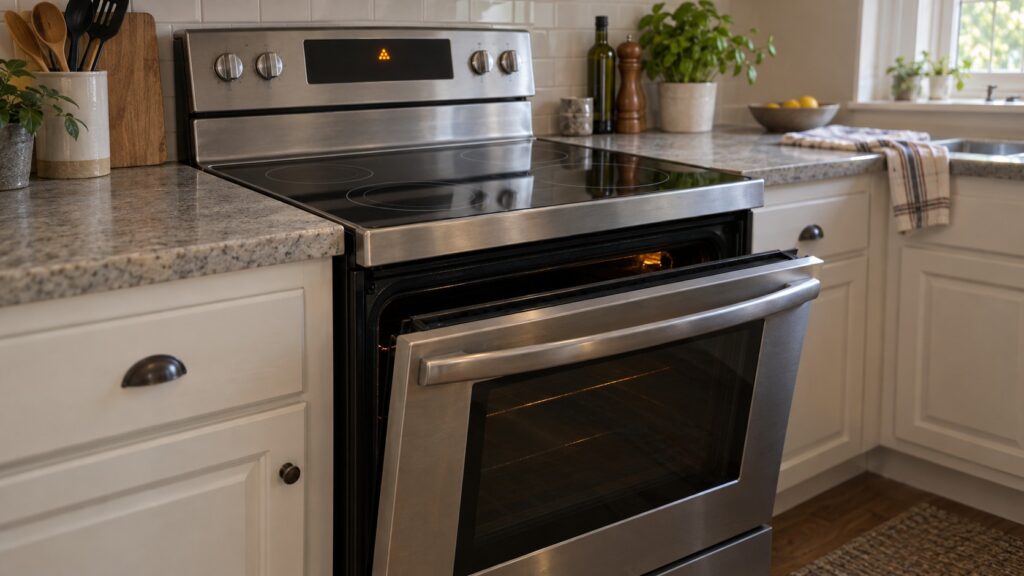
A Bosch oven E115 means the oven cavity went above the temperature the control board is allowed to permit, and the overheat protection shut the heat down. On this site the code is filed under the range rather than the wall oven, because that is the board that raises it: E115 belongs to the oven cavity of a Bosch range, the one under the cooktop. The code is not a complaint about the sensor being unreadable — it is the opposite. The board read a number it believed, and the number was too high.
That distinction decides everything you do next, so it is worth seeing the neighboring codes laid out. They all touch the same cavity and they mean four different things.
What does E115 actually measure?
The oven has two independent ways of knowing it is too hot. The first is the cavity sensor, the thin probe in an upper corner that the board reads continuously. The second is a mechanical limit device — a thermal cut-out clipped to the cavity wall or the element bracket — that opens a circuit outright if the first line fails. E115 is the board acting on the first of those: the sensed temperature crossed a ceiling that no normal cycle should reach, so the board dropped the heat and latched a code.
Because the board trusts the sensor, a Bosch oven E115 has two very different root causes that look identical from the front. Either the cavity really did overheat, or the sensor is telling the truth badly. A short circuit in a resistance sensor reads as a very low resistance, which the board interprets as a very high temperature — which is exactly why E014 sits next to E115 in the list above. The code page for this fault is Bosch range error code E115, and the sensor codes are E014 and E012.
Why does my code say oven when the page says range?
People type what they cook in. A Bosch range has an oven inside it, so searching for an oven code is the natural thing to do, and this site keeps the code under the appliance whose board issues it. If you have a built-in wall oven rather than a range, its numbering starts elsewhere — an open sensor circuit there is E011, not E012, and our Bosch oven E011 guide covers why the same three digits do not travel between the two.
Practically, that means one thing: check the badge on the appliance before you follow any instruction you find. A repair written for a wall oven sends you into a cabinet; the same repair on a range means pulling a unit forward on a tile floor with a gas line behind it.
What makes a Bosch oven cavity genuinely overheat?
When the temperature really did run away, the cause is almost always a heat path that cannot close. Four show up repeatedly.
- A stuck element relay. The board commands heat on and off through relays. A relay whose contacts have welded shut keeps the element energized after the call for heat ends, and the cavity climbs past the setpoint until the protection trips.
- A blocked cooling fan or vent. The fan that draws air across the electronics and out the vent trim also limits how hot the cavity structure gets. If it has stopped, or if the vent slot behind the cooktop is packed with grease, the oven runs hotter than its own numbers predict.
- A self-clean cycle gone wrong. Pyrolytic cleaning deliberately runs the cavity far above cooking temperatures. If the door lock, the fan or the sensor is marginal, that is the cycle where the ceiling gets crossed. Our self-clean guide covers what the cycle is supposed to do.
- A door that no longer seals. A crushed or hardened gasket lets hot air spill over the sensor’s corner of the cavity while the middle stays cooler, so the board sees a spike that the food never gets.
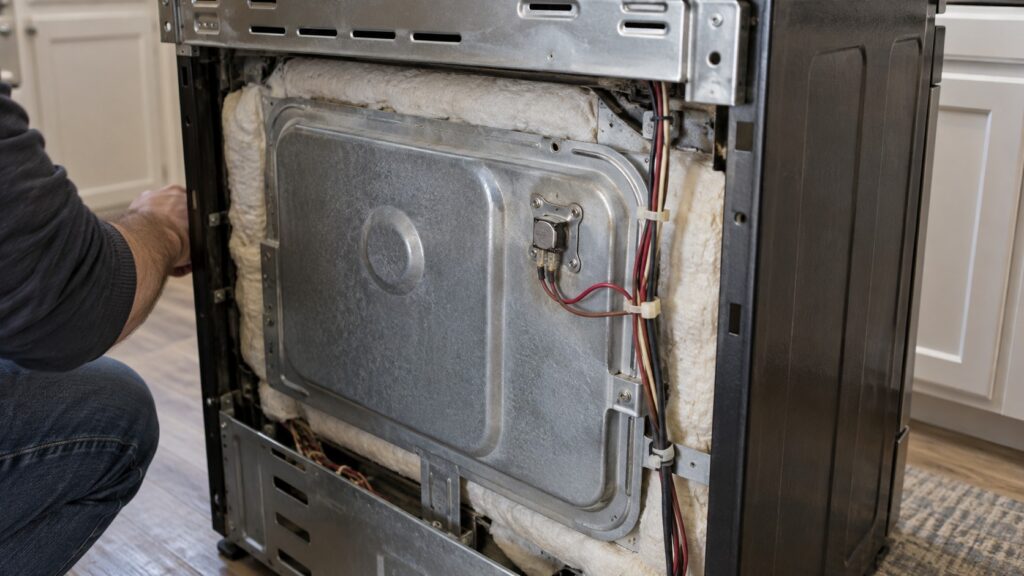
Stop before the back panel. The element terminals, the relay board and the thermal cut-out all sit on mains voltage, and on a gas range the oven burner and its valve are behind the same panel. Pull the breaker and, on a gas model, close the supply valve before anything is unscrewed.
What can I check without opening anything?
More than you would expect. Cut the power for two minutes and see whether the code returns on a plain bake cycle at a moderate temperature; a code that only appears on self-clean or on broil narrows the fault to the high-heat path. Watch the vent above the door: you should feel the cooling fan moving air within a minute of the oven reaching temperature, and a fan that never stops or never starts is a finding in itself. Put an oven thermometer on the middle rack and compare it with the setpoint — a cavity that reads far above its setting is a real overheat, while one that reads correctly while the board panics points at the sensor circuit.
What you should not do is reach for calibration. Adjusting the offset shifts the whole scale by a few degrees and is the right tool for a cake that browns too fast. It cannot move a ceiling that the protection circuit enforces, and dialing an offset in to hide a spike only delays the same shutdown.
When does this become a service call?
A welded relay, a failed thermal cut-out and a shorted sensor are all board-side or behind-the-panel work on a unit that has to come forward off its anti-tip bracket, and on a gas range that means breaking a gas connection. If the code appears on ordinary baking rather than only on self-clean, if it appears with a burning smell, or if it returns after a new sensor has been fitted, the overheat is real and the part that should have limited it has not.
We are an independent repair company, not a factory service arm. Pricing starts from a diagnostic visit and we confirm the estimate before any work begins. Bosch range repair covers sensors, relays, thermal cut-outs and control boards, and you can schedule a visit online. Until then, leave the oven off at the breaker — a protection circuit that has already fired once is not a system to test twice.