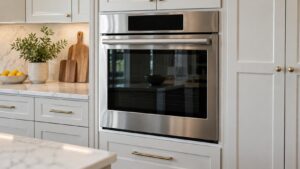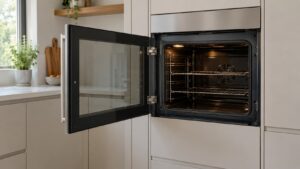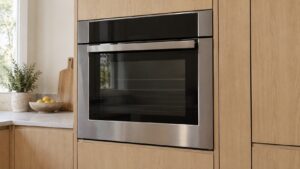
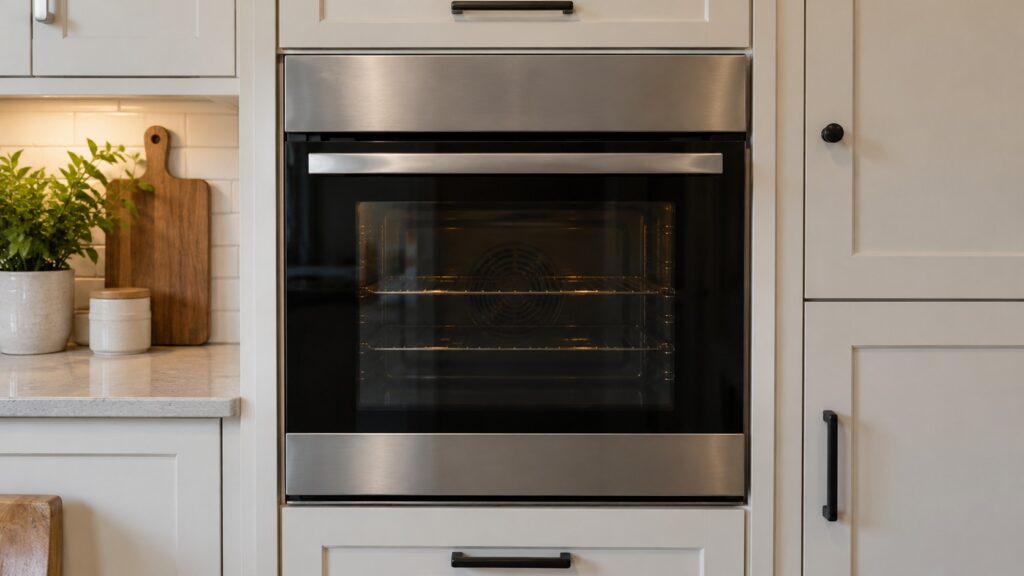
A Bosch 27 inch wall oven is built for a 27-inch cabinet cutout, and a 30-inch oven will not fit in that opening. That is the single most important fact when you are replacing an older built-in oven or planning a kitchen around one. On our site the 27-inch model is the Bosch HBN8451UC, an 800 Series single wall oven, and there is also a 27-inch 500 Series double oven, the HBL5751UC. This guide explains how to match the oven to the cutout, what to measure and what to leave to the installation sheet and a qualified installer.
Which Bosch ovens fit a 27-inch cutout?
Our HBN8451UC model page describes it as the 27-inch variant of the 800 Series wall oven, designed for kitchens with 27-inch cabinet cutouts where a 30-inch unit will not fit. It lists European convection, a TFT color touch display, eleven cooking modes, Home Connect Wi-Fi, a self-clean function and a capacity of 4.1 cubic feet. The 500 Series HBL5751UC is described as a 27-inch double wall oven with European convection in both cavities.
Most of the other Bosch wall ovens on our site, such as the HBL8454UC and HBL8443UC, are 30 inches wide. If your existing opening is narrow, do not shop only by series name. Read the width on the model page first. Our guide to the Bosch HBL8454UC covers one of the 30-inch models for comparison.
How do you check that the oven matches your cabinet?
Start with the model number of the oven you plan to buy and open the installation sheet for that exact model. It gives the cutout width, height and depth, the clearances around the oven and the rules for the surface below it. We deliberately do not quote those dimensions here, because they are model-specific and a single error costs you a cabinet. What we can say in general is how to prepare.
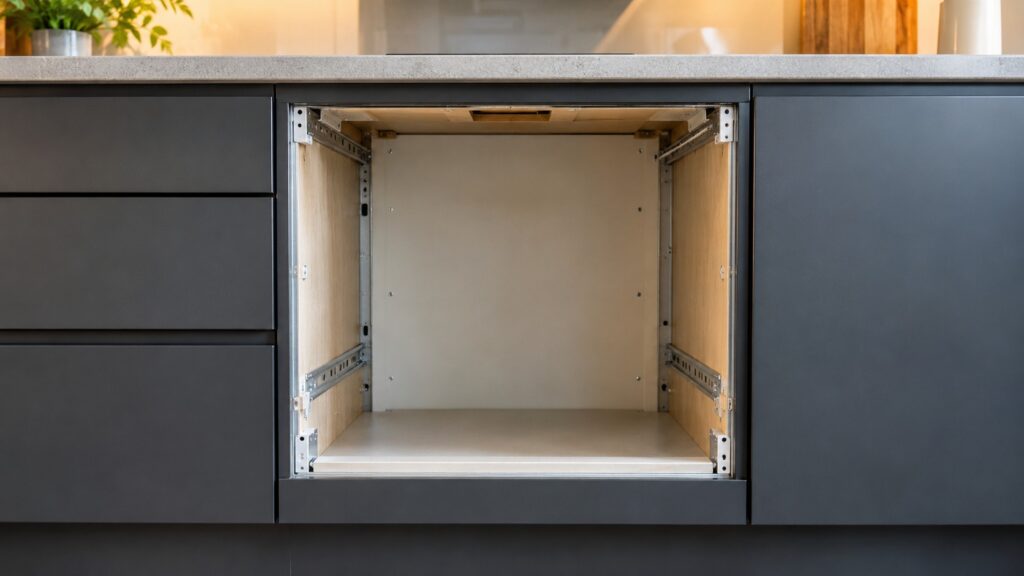
Measure the existing opening in several places, not one: the top, the middle and the bottom for the width, and the left and right for the height. Cabinets are rarely perfectly square. Write down the measurements and compare them with the sheet. Check that the floor of the cutout is flat, solid and level, and that nothing such as a drawer slide or a trim strip intrudes into the space. Also look at where the power supply comes into the cabinet, since the connection point has to match the position given in the sheet.
What if the opening is 30 inches and you want a 27-inch oven, or the reverse?
A narrower oven in a wider opening needs a trim or filler solution, and a wider oven in a narrower opening does not fit at all. Do not cut or modify the cabinet yourself to squeeze an oven in. The cabinet carries the weight of the oven, and cutting into it can weaken the support or remove the clearances the oven needs for cooling air. If you want to change the size of the opening, that is a job for a cabinetmaker working from the installation sheet, and it should be decided before the oven is ordered.
Our guide on Bosch wall oven installation requirements explains the general requirements that apply to every Bosch wall oven, such as the cabinet, the ventilation around the oven and the power connection. Read it alongside the sheet for your 27-inch model.
Who should connect the oven to power?
A built-in wall oven is a hard-wired appliance, so the connection is made at a junction box with the correct circuit and wire size for that model. The installation sheet states the requirement. We do not give amperage or wire sizes here, and we do not recommend doing the connection yourself unless you are a qualified electrician. Switch the circuit off at the breaker panel before anything is touched, and confirm it is dead with the right tester, which is the electrician’s job.
Wall ovens are heavy and awkward. Plan for two people to move the oven into the opening, protect the cabinet edges and the oven’s front, and never lift it by the door or the handle. Do not remove the door unless the installation sheet tells you to and shows how, since our oven pages treat door removal as its own topic. After installation, a first heat-up often produces a light smell from manufacturing residues; follow the manual for how to run that first cycle, and ventilate the kitchen.
What should you check after the oven is in place?
Once the oven is installed and the power is on, check that it sits level and square in the opening and that the door opens fully without catching the cabinet. Look for even gaps around the front frame. Run the display through its first-time setup using the owner’s manual, and if you plan to use Home Connect, follow the manual’s steps for pairing with your phone. Keep the installation sheet and the manual with your records, because service technicians use the model and series numbers from the label.
If the oven does not heat, trips the breaker, or shows a fault on the display straight after installation, switch it off at the breaker and do not keep trying. A new installation that fails often points to a connection or a setup problem, and an installer or technician should look at it. Our convection oven explainer is a useful read for understanding what the oven should be doing once it is running.
When should you call us?
Call if the oven was installed recently and does not work properly, if the door does not close or the oven does not sit level, or if an older 27-inch oven fails and you want to know whether it is worth repairing. We are an independent repair company, not Bosch, and we service Bosch ovens. See our Bosch oven repair page, or schedule a visit online. For help deciding about an older oven, read repair or replace a Bosch oven.