Bosch AutoAir and PureDry are two of the drying systems named on Bosch dishwasher model pages. AutoAir is a drying system in which the door opens automatically at the end of the cycle so moisture can escape and fresh air can circulate. PureDry is the name the model pages use for condensation drying, where the stainless steel tub and the air inside it do the work without a dedicated drying add-on. This glossary explains both terms, shows which models carry each, and how they differ from CrystalDry.
What is Bosch AutoAir drying?
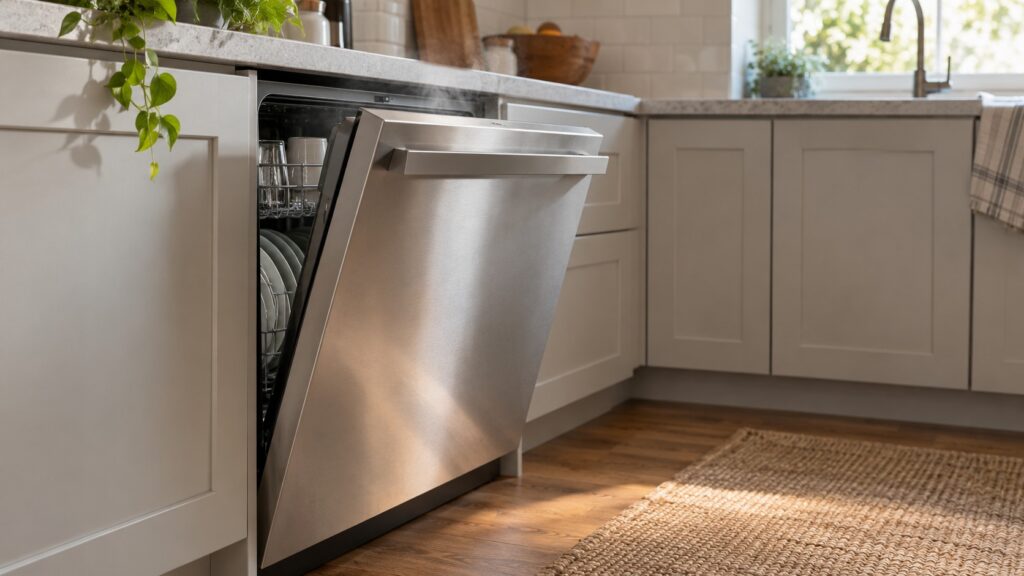
On the Bosch dishwasher model pages on this site, AutoAir is described as a technology in which the door automatically opens at the end of the cycle to let moisture escape and fresh air circulate for better drying. The key idea is simple: wet dishes dry faster when humid air can leave the tub, and a door that has been cracked open does that without you standing by the machine. The pages list AutoAir on the 500 Series, for example the SHP65CM5N and the SHPM65Z55N, both top-control dishwashers with a standard third rack and Home Connect.
Because the door moves on its own, leave space in front of the dishwasher at the end of a cycle. A kitchen with a drawer, a person or a pet in that spot can be caught off guard by a door that is no longer latched. If your model has this feature, read the section on it in your owner’s manual so you know how wide the door opens and whether you can switch the feature off.
What does PureDry mean on a Bosch dishwasher?
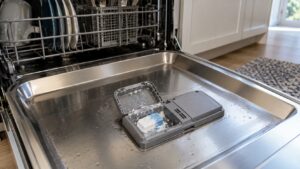
PureDry appears in the Drying line of the specifications as PureDry condensation. It is the drying approach on the entry and mid-level models: the SHE3AEM6N, SHE4AEM6N, SHX5AEM5N and SHXM4AY55N from the 100 Series, and the SHE53B75N, SHP53T55N and SHS43CF5N from the 300 Series. In condensation drying, the hot, moist air in the tub meets the cooler stainless steel walls, and the moisture collects there and drains away, rather than being pulled out by a separate drying unit. Several model pages point out that a stainless steel tub keeps heat well and improves drying for that reason.
In practice, PureDry is a good everyday system, but it relies on a hot final rinse, the right amount of rinse aid and sensible loading. Plastic items hold less heat than glass and china, so they are the pieces most likely to come out damp. That is true of condensation drying on any brand, and it is not a fault.
How is AutoAir different from PureDry and CrystalDry?
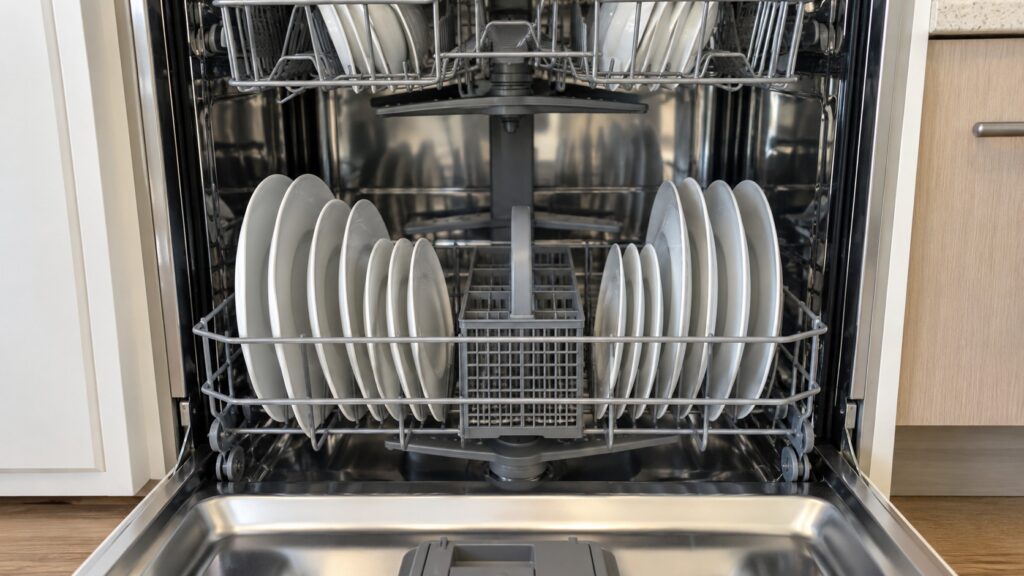
The three terms describe different approaches, and they do not describe a ranking you can read from the name alone. PureDry is condensation drying. AutoAir adds an automatic door opening at the end of the cycle. CrystalDry, found on the 800 Series pages such as the SHP78CM5N and the SHPM88Z75N, uses Zeolite, a natural mineral, to turn moisture into heat, and the pages credit it with better drying even on plastics. We keep a separate entry for it in our CrystalDry glossary.
When you compare dishwashers, look at the Drying line first, then at the exact model, because the drying system is listed per model. Do not assume a model carries a system because a sibling or a model in the same series does: always read the specification line of the exact model number on your data plate or in your manual.
What is the ExtraDry option?
The SHE4AEM6N page lists an ExtraDry option that boosts drying performance with higher rinse temperatures. It is an add-on to the normal cycle rather than a drying system in its own right, and it makes sense when you wash a lot of plastic or a heavy load. Higher rinse temperatures can be harder on delicate items, so check the care label of your glassware and wooden items before you use it. For how this option fits with the other settings, read our guide to Bosch dishwasher cycles and settings.
Why are my dishes still wet with AutoAir or PureDry?
Wet dishes are usually a loading, rinse aid or cycle choice problem, not a broken drying system. Check that you did not choose a short cycle, that the rinse aid dispenser is full, and that cups are tilted so water does not pool in the bottoms. Our guides on Bosch dishwasher drying and on rinse aid dispenser problems cover these points in order.
If a dishwasher also leaves the tub cold, check whether it is heating the water at all. A dishwasher that never gets warm will not dry by condensation, and the cause could be the heating system rather than the drying feature. Our article on Bosch dishwasher heating problems explains the symptoms. Do not open the tub base or touch wiring yourself: switch the breaker off and call a technician.
We are an independent repair company, not the manufacturer. Our Bosch dishwasher repair page explains a visit, and you can schedule a visit online.