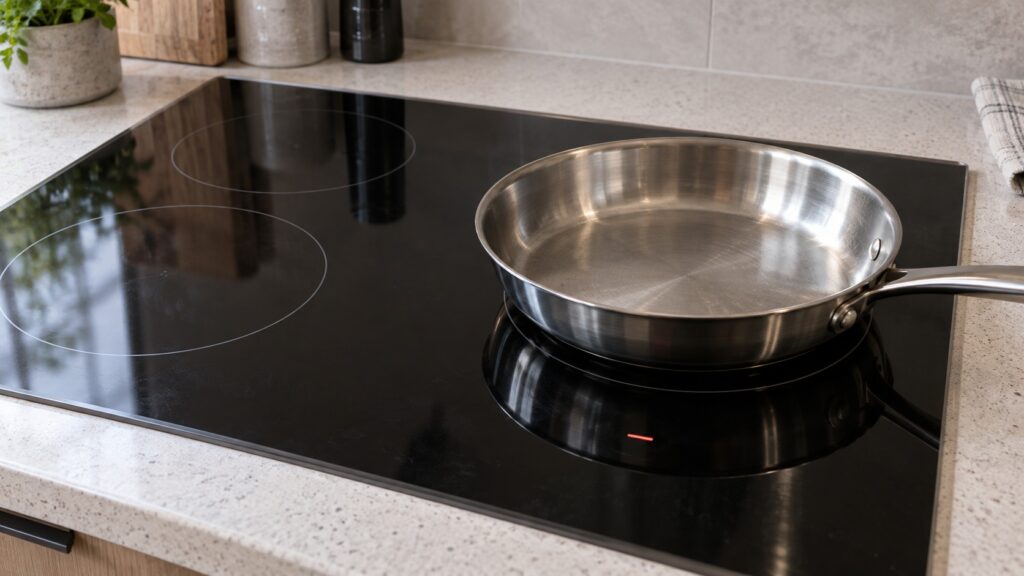
When a single zone on a Bosch induction cooktop stops heating while the rest of the surface works, the cause is almost never the glass and almost never the whole appliance. It is one of four things: the pan is not being recognized, the zone has been bridged or limited by a neighboring zone, the electronics under the glass have overheated and pulled that zone back, or the coil or its power board has failed. Bosch cooktop repair on an induction surface starts by telling those four apart, and the first two cost nothing to check.
Induction is a different appliance from a radiant surface, and that is why the usual advice does not transfer. There is no element to burn out and no spark module to clean. A coil under the glass raises a magnetic field, and the pan itself becomes the heater. If the pan does not respond to the field, the electronics see no load and refuse to deliver power — from the front, that looks exactly like a dead zone.
Is it the cooktop or the pan?
Test it in thirty seconds with a refrigerator magnet. If the magnet does not stick firmly to the base of the pan, that pan will never work on induction, whatever the box said. Aluminum, copper and most fully austenitic stainless steel are invisible to the field. A pan with a thin magnetic disk bonded to an aluminum body works, but works poorly on a large zone, and a warped base that no longer lies flat loses contact in the middle and heats in a ring.
Size matters as much as material. Every zone has a minimum diameter it will recognize, and a small saucepan centered on a large zone can sit just under that threshold — the zone accepts it one day, rejects it the next as the pan shifts. If one zone refuses a pan that every other zone accepts, try the same pan centered carefully, then try a heavier pan of the right size before concluding anything about the appliance. Our guide to how Bosch induction cooktops work covers the detection logic in more detail.
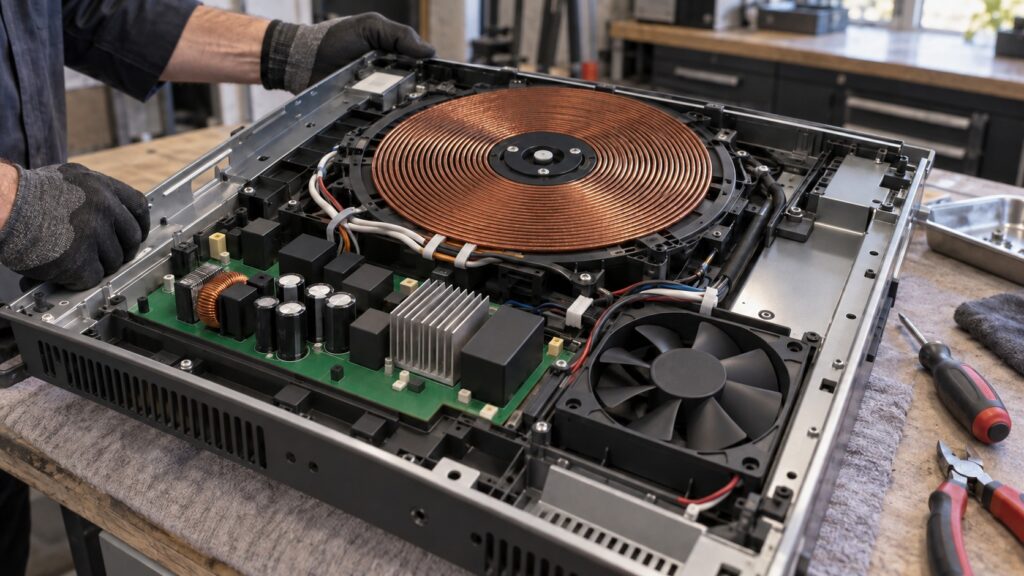
Why did the zone cut its own power?
Induction electronics run hot and sit in a shallow space directly under the glass. A fan draws air through the underside of the cooktop, and when that airflow is restricted the control protects itself by reducing output — sometimes on one zone, sometimes across the surface, sometimes shutting a zone off entirely until it cools.
The restrictions are usually installation, not failure. A cooktop set over a drawer with no ventilation gap, a built-in oven immediately underneath running a self-clean cycle, a filter or a cabinet back that blocks the intake, or simply a long session of high-output cooking on a hot day. If the zone recovers after twenty minutes with the surface off, you have found it. If a wall oven sits below and the problem only happens during long roasts, the two appliances are fighting over the same air.
What is a bridged zone doing to my pan?
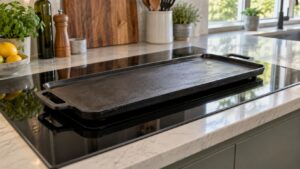
Bosch’s flexible zones let two coils be driven as one area, so a griddle or a fish pan can span them. That is a feature until it is switched on by accident: once two zones are linked, setting one and expecting the other to stay independent produces exactly the symptom people report as a dead zone. The linked pair also shares its power budget, so pushing one half to boost pulls the other half down.
Check the panel for a link or bridge indicator between two zone displays and clear it. The naming and behavior of the flexible area are covered in our FlexInduction glossary entry. Even without an explicit bridge, zones are paired to power stages: on many cooktops the left pair share one generator and the right pair another, so a boost on one side legitimately limits its neighbor. That is designed behavior, not a fault.
What can I check before booking Bosch cooktop repair?
- Power down at the breaker for two minutes. An induction cooktop is a computer with a hot plate attached, and a latched fault clears the same way any other does.
- Try every zone with the same known-good pan. One zone failing a pan that three zones accept is a zone fault. All four failing it is the pan.
- Look for a code, not just a dash. A blank or dashed display is detection; a letter and number is the control reporting something specific, and it is worth writing down exactly.
- Listen. Induction is not silent — a faint hum from the pan and the fan running under the surface are both normal. A fan that never starts is a finding.
- Check the breaker itself. An induction cooktop is usually on a dedicated high-current circuit, and on a two-pole breaker a single tripped leg can leave half the surface alive.
Stop there. The glass is bonded to a frame, the power boards below hold a charge after the supply is cut, and the connections behind the cooktop carry the full circuit. Lifting an induction cooktop out of a countertop is not a homeowner job, and a cracked top is not repairable — it is a new appliance.
When is a dead zone a real repair?
When the panel works, the pan is proven on other zones, the cooktop has cooled fully, and no bridge is active — and the zone is still dead. At that point the fault is the induction coil itself, the power stage that drives it, or the harness between them, and all three live under the glass. The good news is that a single-zone failure usually leaves the rest of the cooktop safe to use in the meantime; a cooktop that trips the breaker or shows scorching around a zone should be switched off at the panel instead.
If you are weighing this against replacing the appliance, our gas versus electric comparison and the lifespans guide are the context. If the surface in question is gas rather than induction and a burner will not light, you want the burner ignition guide instead — a clicking igniter and a silent induction zone have nothing in common but the countertop.
We are an independent repair company, not a factory service arm. Pricing starts from a diagnostic visit and we confirm the estimate before any work begins. Bosch range and cooktop repair covers induction coils, power boards and control electronics, and you can schedule a visit online or call 1-844-731-6692.