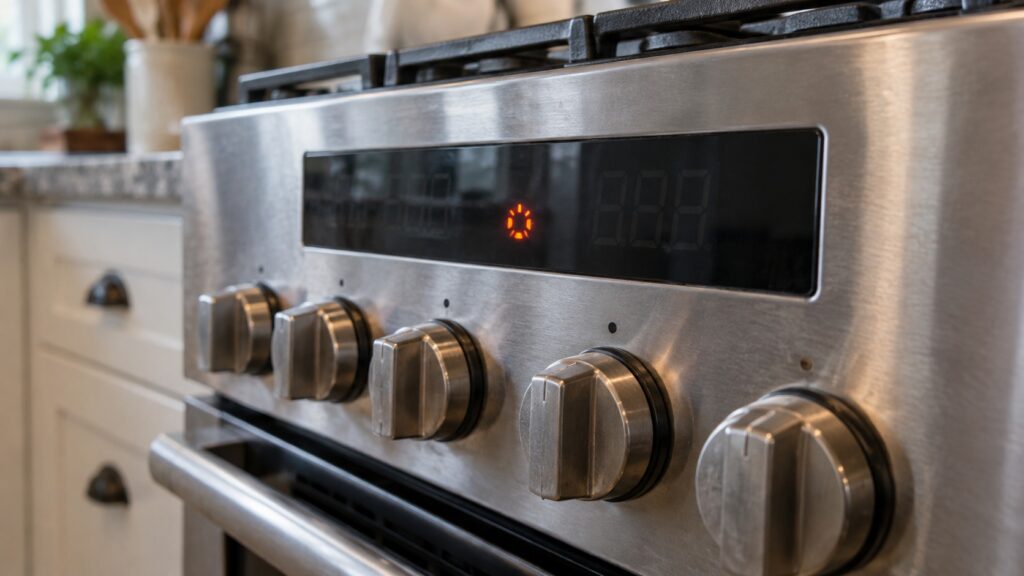
A Bosch e305 is a communication error between the boards inside a Bosch range: the control board reported that it could not talk properly to the other electronics, and it stopped the cycle rather than act on instructions it was not sure it had received. It is not a sensor code, not a burner code and not a user error. Nothing you change in the settings will move it, and no amount of cleaning will either.
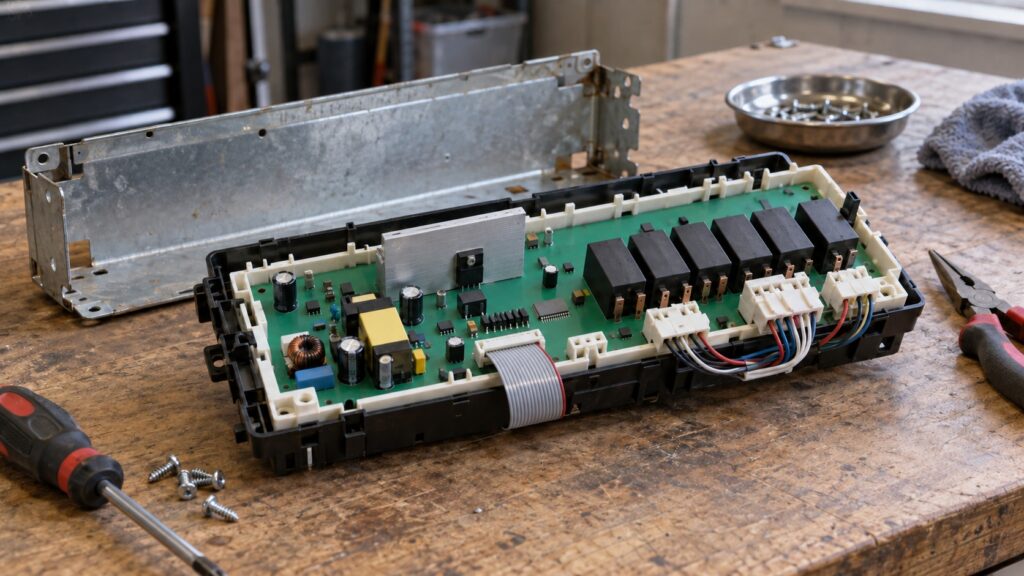
Ranges carry more than one board. There is the main control board behind the panel, the display and touch electronics the board drives, and on induction and dual-fuel models a separate power board for the cooktop. E305 is raised when that conversation breaks down.
What is a communication error between boards?
The boards inside a range are not wired point to point for every function. They exchange short messages over a few conductors, each one acknowledged, so that a command to open a gas valve or energize an element is only acted on when both ends agree it was sent. When acknowledgements stop arriving, or arrive corrupted, the sending board has a choice: guess, or stop. Bosch chose stop, and the code you see is the record of that decision.
What makes Bosch range error code E305 awkward to diagnose is that the symptom does not point at the broken piece. A silent display can mean the display board failed, or that the main board stopped feeding it, or that the ribbon between them lost a conductor. All three produce the same number.
Is the board actually dead, or just not talking?
Those are different repairs with different costs, and the site keeps them under different numbers for that reason. E305 says the link failed. E100 says a board’s own self-check failed. A range that shows E305 intermittently, clears on a power cycle and runs a full bake afterward usually has a connection problem — a ribbon cable that has walked out of its socket, a connector pin greened by moisture from the cooktop above, or a harness pinched when the unit was last pushed back into its cabinet. A range that shows the code the moment power is restored, every time, is more likely to have a board that has genuinely failed.
The heat is the reason these connectors age. A range’s electronics live directly above the oven cavity and directly below a cooktop, and they see a thermal cycle every time anyone cooks. Twenty years of expansion and contraction is enough to loosen a press-fit connector that was never disturbed by human hands.
What can I safely check before calling anyone?
Very little inside the range, and that is the honest answer. The control board sits behind the panel with mains voltage on its relay side, a gas valve within reach on a gas model, and the cooktop power board on an induction model holding a charge in its capacitors after the power is off. This is not a panel to open on a Saturday morning.
- Cut power at the breaker for five minutes. Not the control lock, not the clock reset — the breaker. Many communication faults are latched, and a full power-down is the only reset that clears the latch.
- Note exactly when the code appears. On power-up, at the start of a bake, only when a cooktop zone is switched on, or only after an hour of cooking. Each of those points at a different board.
- Check the other functions. If the clock holds time and the cooktop works while only the oven refuses, the main board still has power and its link to one subsystem is the problem.
- Look at the outlet, not just the range. A loose neutral or a shared circuit sagging under another load drops the supply enough to upset the electronics, and that shows up as a communication complaint long before anything else in the kitchen misbehaves.
Can I keep cooking while the code is on the display?
Treat it as no. A board that cannot confirm its own instructions should not be trusted to stop a gas valve or an element when you ask it to, and on a gas range that is the whole argument. If the range is your only cooking appliance, use the breaker as your off switch between attempts rather than leaving a faulted control powered overnight.
The one exception worth naming is the cooktop on a model where the surface burners are mechanically valved and ignite independently of the oven board. Even then, a code that appears while a burner is lit is telling you the shared electronics are involved, and our burner ignition guide is the place to check whether what you are seeing is an ignition fault wearing a communication code’s clothes.
When is a board worth replacing?
This is the code where the repair-or-replace question is real rather than rhetorical. A main control board is one of the more expensive single parts in a range, and on an older unit it can approach a meaningful fraction of a new appliance. The calculation turns on three things: how old the range is, whether the board is still made for that series, and whether anything else on the appliance is already marginal. Our repair or replace guide works through that arithmetic, and the lifespans guide gives the context on where a fifteen-year-old range sits.
What tips the decision often is the diagnosis itself. If the fault turns out to be a ribbon cable or a corroded connector, the repair is small and the range has years left. If both boards test bad, the conversation changes. That is why the visit starts with measurement rather than a parts order.
We are an independent repair company, not a factory service arm. Pricing starts from a diagnostic visit and we confirm the estimate before any work begins. Bosch range repair covers control boards, display electronics and the harnesses between them, and you can schedule a visit online or call 1-844-731-6692.