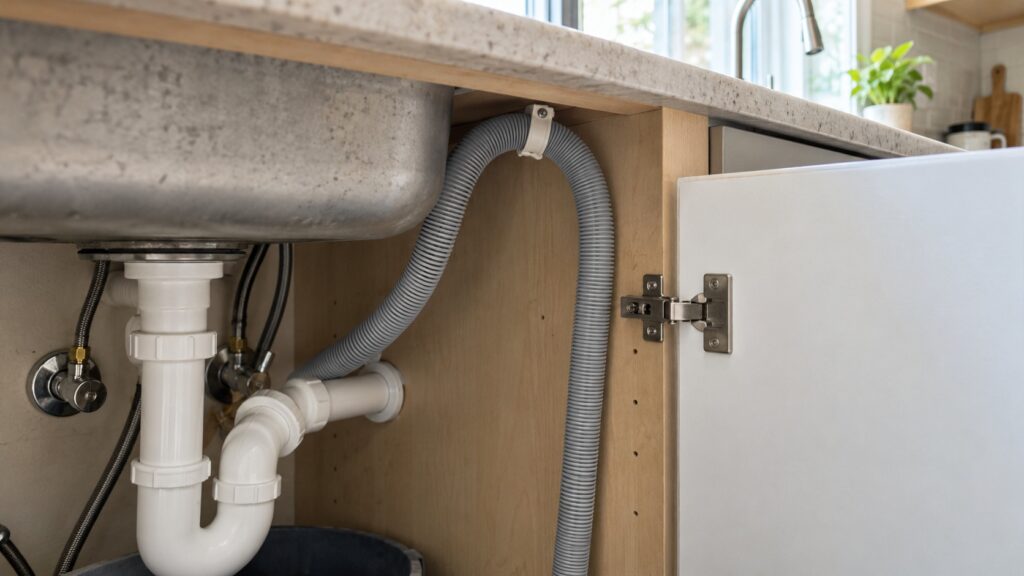
A Bosch dishwasher drain hose has one job that installers get wrong more than any other: it must rise high under the countertop before it drops to the drain, so wastewater from the sink or disposal cannot siphon or flow back into the tub. That rise is called a high loop. Some local plumbing codes require a standalone air gap on the countertop instead, so check which your area uses before you finish the connection.
What is a high loop on a Bosch dishwasher drain hose?
A high loop is the section of the drain hose that is lifted and secured as high as possible against the underside of the countertop, then allowed to drop down to the sink drain or disposal. The rise acts as a barrier. Water leaving the dishwasher is pushed over the top by the drain pump, and water standing in the sink or disposal cannot climb back over it. Without that rise, a clogged sink can send dirty water into the tub, and a loose hose can siphon the dishwasher dry.
The hose that ships with a Bosch dishwasher is usually ribbed and flexible, and it is long enough to reach the top of the cabinet and then the drain connection. Your installation manual gives the exact height the loop must reach. Whatever the number, the principle is the same: the highest point of the hose should sit well above the water level in the sink drain.
How do you route a Bosch dishwasher drain hose correctly?
Start with the machine out of the opening, powered off at the breaker and with the water supply shut. Feed the drain hose through the cabinet side wall hole without kinks, then lift it toward the top of the cabinet and secure it with a clamp or hook against the underside of the countertop. Let it fall in a smooth curve to the drain connection. Avoid sharp bends, since a crimp reduces the flow just as a clog would.
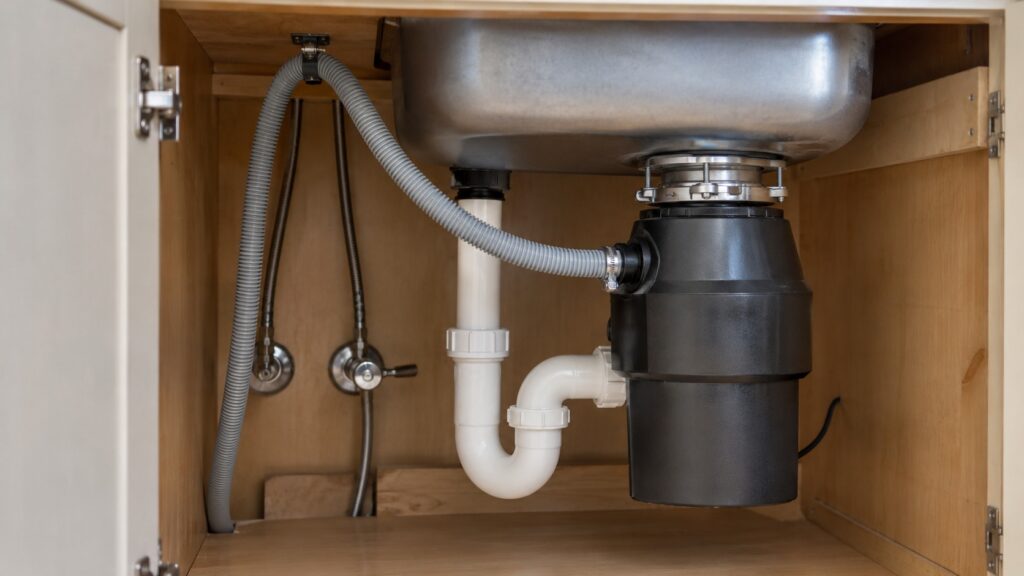
Attach the hose to the disposal inlet or the drain tailpiece with the supplied clamp, and tighten it so it holds under the drain pump’s pressure without crushing the hose. Keep the hose clear of the sink’s moving parts and make sure nothing presses on it when the dishwasher slides back into the opening. Many drain problems turn out to be a hose pinched between the unit and the cabinet wall during the final push. Our Bosch dishwasher installation requirements guide lists the rest of the clearances and connections.
When do you need an air gap instead?
An air gap is a small cylindrical fitting that mounts through the sink or countertop, often next to the faucet. The dishwasher hose runs up to it, and a second hose leads from it to the disposal or drain. The fitting breaks the connection with a physical gap of air, which is the most reliable backflow protection. Some jurisdictions require it by plumbing code, while others accept a properly secured high loop.
Because requirements vary, check your local code or ask the plumber or inspector before you decide. An air gap is a reasonable choice even where it is not required, since it gives a visible check on the drain: if it overflows, you know the drain line is blocked. The downside is an extra fitting on the countertop and sometimes a gurgle or a small leak of water at the fitting if the downstream hose is partially blocked.
What about connecting to a garbage disposal?
If the dishwasher drains into a garbage disposal, the disposal has a small plastic knockout plug inside its dishwasher inlet. That plug must be removed before the dishwasher is connected, or the dishwasher cannot drain at all. It is one of the most common causes of a brand new dishwasher that leaves a full tub of water. Remove it by tapping it out with a screwdriver, then fish the plug piece out of the disposal chamber so it does not jam the grinder.
Connect the hose to the inlet with a clamp and run the disposal briefly to confirm that water flows through. If you do not have a disposal, the hose connects to a dedicated fitting on the sink drain tailpiece, again with the loop above it.
What does a bad drain hose layout look like?
The signs are consistent. The dishwasher drains slowly or leaves a pool of water in the bottom of the tub. You may hear gurgling from the sink when the machine drains, or smell a sour odor caused by water that cannot leave. In some cases the dishwasher reports a drain-related error. Our Bosch dishwasher not draining troubleshooting guide covers the filter, pump and blockage checks to run once you have confirmed the hose layout.
A quick inspection under the sink often settles it. Look for a hose that sags below the drain, a hose crushed against the cabinet wall, a missing clamp, or a disposal plug that was never removed. Fixing any of these takes minutes and costs nothing. If the layout is correct and the dishwasher still will not drain, the cause is more likely a clogged filter, a failed drain pump or a blocked drain line.