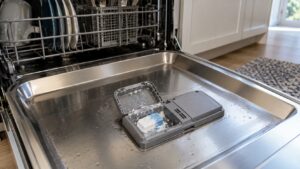
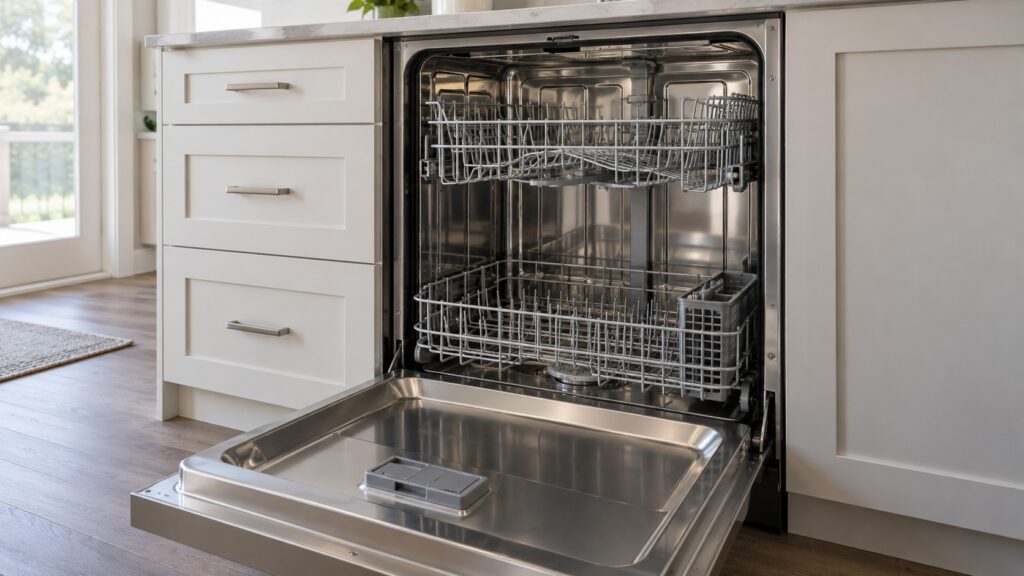
To do a Bosch dishwasher descale, first clean the filters, spray arms and door gasket, where hard water deposits collect first, and then run an empty hot cycle with a dishwasher cleaner that your owner’s manual allows. That routine removes most of the white film and cloudiness that people blame on the machine. This guide explains how mineral buildup shows up, what to clean in which order, what not to use, and how to tell scale from a real fault such as a failed heater.
How do you know a Bosch dishwasher has limescale?
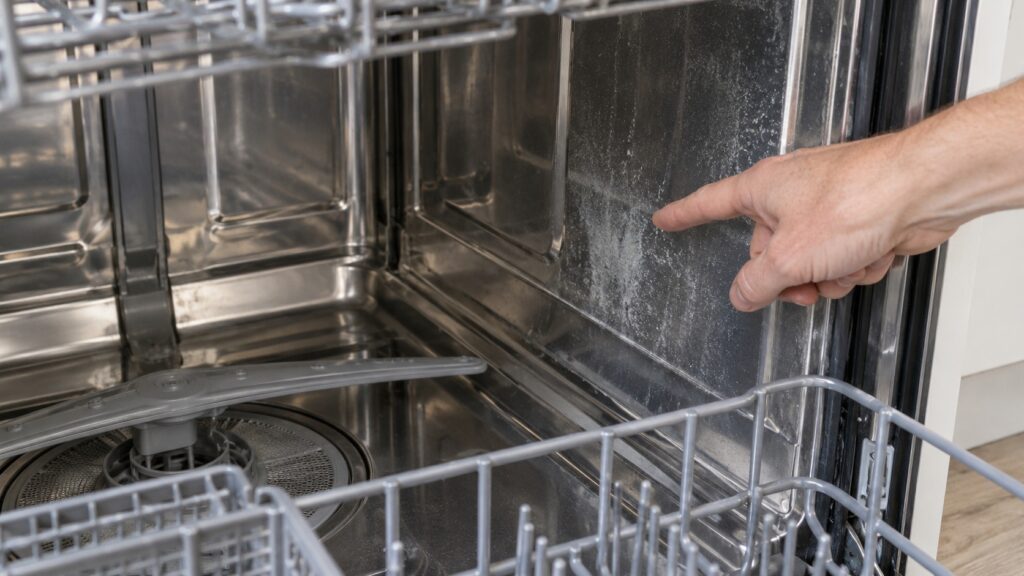
Hard water leaves minerals behind each time water dries. In a dishwasher that appears as a white or grayish film on the stainless steel tub, a cloudy haze on glassware that does not wipe away with a cloth, and a rough coating on the spray arm holes and the filter. Our guides on spray arm maintenance and filter cleaning both mention hard water deposits as a cause of poor cleaning, so those parts are the first checkpoints.
A quick test: rub a wet fingertip on the film. If it feels chalky and a cloth with a little white vinegar wipes it off, it is probably mineral, and a vinegar soak is what our spray arm guide uses for mineral deposits on removed arms. If it is greasy and smells, it is soil and detergent residue, which filter and arm cleaning will handle. A cloud on glass that does not wipe off with vinegar may be etching, which is damage to the glass surface that no cleaner can reverse. The Bosch model pages on this site do not describe a built-in descaling program, so use the steps here and follow your manual.
What should you clean before running a machine care cycle?
Clean in this order, because loose debris will otherwise rinse into the pump. Pull the lower rack, then remove the filter assembly following the steps in our filter guide. On the Bosch models described there it has a cylindrical micro-filter, a flat coarse filter and a fine mesh; rinse them under warm water with a soft brush and no abrasive pads. Check the small flap over the drain pump opening moves freely.
Next, remove the spray arms if your model allows it, rinse them and clear each hole with a toothpick. Never use metal wire, which can enlarge the holes and change the spray pattern. Finally, wipe the door gasket, the edge of the door and the detergent compartment with a damp cloth and mild dish soap. Dry food and detergent crust there feeds odors. Spend a few minutes on this before any cleaner goes in, since a clogged filter can make even a good cleaning cycle ineffective.
How do you run a descaling or machine care cycle on a Bosch dishwasher?
Use a cleaner made for dishwashers and follow the instructions on its label and in your owner’s manual. The exact product and where it goes, in the dispenser, in a cup in the lower rack or on the tub floor, depends on the cleaner and the model, so we cannot give one answer for every unit. Run the dishwasher empty, with the filters and spray arms back in place, on a hot cycle such as the highest-temperature option your model offers.
If you use a household acid such as white vinegar, check first that your manual does not warn against it, because acids can be a problem for rubber seals on some machines. Never mix vinegar with bleach or other cleaners, since the combination can release hazardous fumes. Ventilate the kitchen, wipe the tub afterward and run a short rinse cycle if any smell remains. Our spray arm guide describes a vinegar soak for removed arms in a basin, which is separate from running vinegar through the machine.
How often should you descale, and does soft water change that?
Our filter guide says Bosch recommends cleaning the filter every two to four weeks depending on use, and the spray arm guide suggests every two to three months for the arms. Treat a machine care cycle as an occasional extra, more often in a hard water area and rarely in a soft water home. If the tub stays clear and glasses come out bright, you do not need to do it on a schedule. Setting rinse aid correctly also matters, and our rinse aid dispenser guide explains the dispenser.
Wash performance also depends on your load. Scrape solid food into the trash, check your manual on whether pre-rinsing is needed, and load plates facing the center. Our dishwasher loading mistakes guide covers the rest.
Is it scale or a heating problem?
Bosch dishwashers heat wash water with a flow-through heater built into the circulation pump assembly and dry by condensation, and there is no exposed heating coil on the tub floor, according to our heating guide. So there is no exposed heating element on the tub floor to inspect or descale. If the wash water is cold, if a code shows on the display or if dishes are wet in every cycle even after cleaning, that is not a cleaning job. Read our guide to Bosch dishwasher heating problems.
Do not remove the kick plate, pump or wiring yourself. Switch the breaker off from a dry spot and call a technician if you see leaking water near electrical parts, or if the dishwasher stops mid-cycle with a fault code. If standing water remains after cleaning the filter, see our not draining guide.
We are an independent repair company, not the manufacturer. Our Bosch dishwasher repair page explains how a visit works, and you can schedule a visit online.