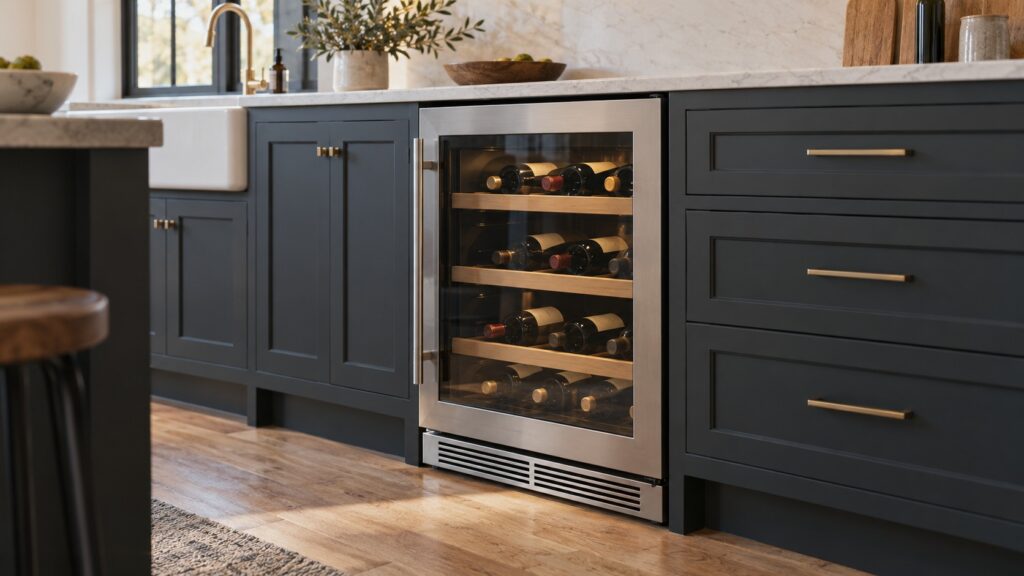
The best Bosch wine cooler storage tips are about how the bottles sit, not only how cold the cabinet is. Store bottles lying down so the cork stays in contact with the wine, load the shelves to the way the shelves were built, keep bottles from touching the cabinet walls or the glass, leave the cabinet steady and do not overfill it. Capacity numbers on our model pages are counted in standard 0.75 L Bordeaux bottles, so wider bottles take more room than the number suggests.
How should you lay bottles in a Bosch wine cooler?
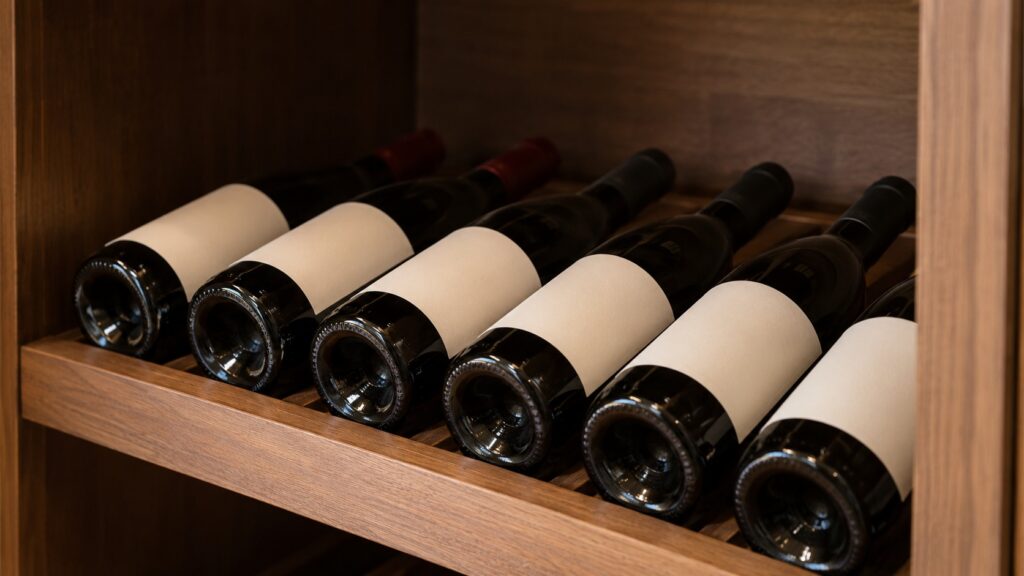
Lay them on their sides, with the label facing up if you want to read it without handling the bottle. A cork that stays in touch with the wine stays moist, and a dry cork may let air in. Screw-cap bottles do not rely on a cork, but storing them on their sides does no harm and uses the space the same way.
Put each bottle in with its neck toward the front or the back according to how the shelf is designed. Do not stack bottles on top of each other on a shelf that was made for one layer. Wooden shelves protect labels and bottles, but they carry a limited load, and a shelf loaded beyond what the manual allows can sag or damage the rails.
How many bottles will your cabinet actually hold?
Our model pages count capacity in standard 0.75 L Bordeaux bottles. The KSW36AI3P is listed at 190 bottles, the KSW30920 at 120, the KWK28AHG0 and the KTW18V82 at 60 and the slim KUR20VHF0G at 21. These are best-case numbers. A Burgundy bottle with a wide shoulder, a Champagne bottle, a magnum or a bottle in a tall, narrow shape does not fit the same slot as a Bordeaux bottle, and a cabinet full of those will hold fewer bottles than the page says.
Plan your layout. Put the bottles that fit the standard slot on the standard shelves and keep the special shapes for the spaces that fit them. If you want to keep a mixed collection in a small cabinet, use one shelf for larger bottles and leave it at that, rather than forcing a bottle in. A bottle that has to be forced is a bottle that can break or crack the shelf.
Which wines go in which zone?
On a dual-zone cabinet, bottles belong in the zone for their style. Our model pages describe dual-zone models such as the KSW36AI3P, the KSW30920, the KWK28AHG0 and the KTW18V82, and the KTW18V82 page says the dual zones suit whites in the upper, cooler zone and reds in the lower, warmer zone. Other models may arrange them differently, so check your manual. Our guide to Bosch wine cooler temperature zones explains the zones and the temperature settings.
Single-zone models such as the slim KUR20VHF0G hold one temperature for the whole cabinet. If you drink both red and white, a single-zone cabinet is a compromise, and our zones guide gives separate suggested temperatures for long-term storage, for reds only and for whites only.
How do you keep bottles safe from vibration, light and odors?
Our model pages stress a low-vibration or anti-vibration compressor and a UV-protected glass door. You can help the cabinet do its job. Keep the cabinet on a steady, level surface so it does not rock, do not put anything on top that vibrates, such as a speaker or a running appliance, and do not slam the door. Our Bosch wine cooler installation guide covers the ventilation and clearance the cabinet needs.
Keep light away from the bottles. A glass door with UV protection helps, but a cabinet in direct sunlight still warms up, so place it away from windows and heat sources. Keep strong-smelling food out of the cabinet and away from the cabinet’s intake. Wine can pick up odors through the cork over time, and our pages mention an activated charcoal filter on some models, which does not replace common sense.
What about the shelves and the rails?
Several of our models list shelves on telescopic rails, including the KSW36AI3P, the KWK28AHG0 and the KTW18V82, while the KSW30920 lists wooden shelves on metal rails. Rails let you pull a shelf out to reach a bottle at the back. Pull a loaded shelf out gently, support the bottles with your free hand and do not push down on an extended shelf, because it can pull the rails out of line. If a shelf catches, take the bottles off before you try to adjust it, and check your manual for how the shelf comes out.
Rotate bottles you plan to drink soon to the front, and keep long-term bottles at the back where they are touched less. Write a simple list of what is in each zone, so you do not stand with the door open while you look.
How often should you open the door, and how full should the cabinet be?
Open it as little as you can. Each opening lets warm room air in, and the cabinet has to cool it again. Decide what you want before you open the door, take it and close it. A cabinet that is nearly empty has less thermal mass than one with a decent stock, and a cabinet that is packed leaves no room for air. Leave small gaps between bottles so air can move.
If you see water on the glass or the door, that is condensation, which our guide to Bosch wine cooler condensation explains. A door seal that is worn will let humid air in, which is why we also have a guide to door seal replacement. For the yearly care of the cabinet itself, see the annual maintenance guide.
When is it a repair and not a tip?
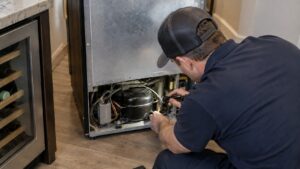
If the cabinet is warm, the compressor never stops, the display shows a code or there is water around the cabinet, no loading tip will fix it. Move the bottles to a cool place, and read our guide on repair or replace if the unit is old. If water reaches an outlet or the cord, switch off the breaker at the panel while standing on a dry floor, and do not pull the plug out of a wet outlet. Do not open the back of the cabinet. We are an independent repair company, not the manufacturer. Our Bosch wine cooler repair page explains how a visit works, and you can book a visit online.