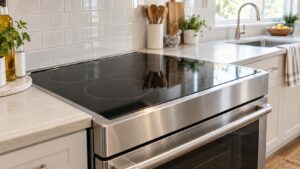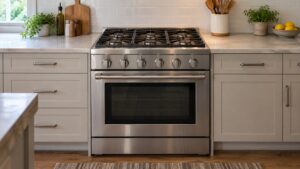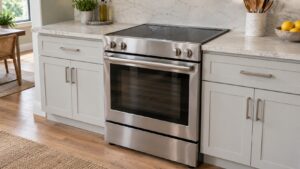
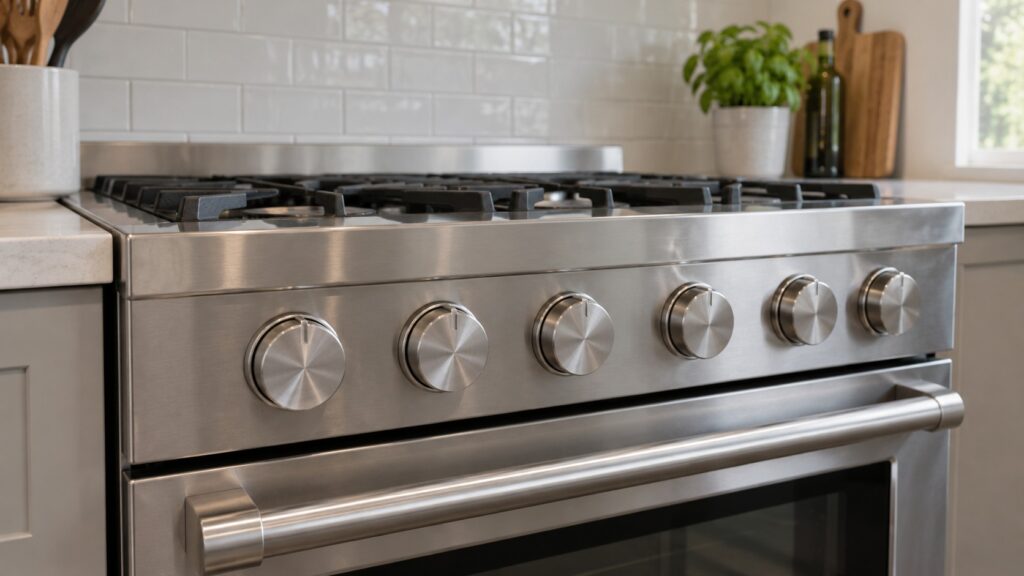
Bosch PreciseSelect is the name our model pages give to a range control layout built around metal knobs. On the HII8046U page it is described as metal knobs that provide the tactile feel of gas controls on an induction cooktop. That is the whole idea: you turn a knob to set the heat instead of tapping a glass panel. The term is a control description, not a cooking technology, and it does not change how the cooktop makes heat.
What does PreciseSelect mean on a Bosch range?
It means the controls are knobs. Several Bosch ranges in the 800 Series pair PreciseSelect with an induction or radiant cooktop and a European convection oven. The wording on our model pages is consistent about the feeling it aims for: tactile feedback and smooth adjustment. The HEI8056U page says PreciseSelect controls with metal knobs offer smooth temperature adjustment, and the HDI8056U page calls it tactile temperature control.
We use the word the way the site does, as the name of a control style. If you want details such as the exact number of detents, the knob torque or how the oven mode is selected, the owner’s manual for your model is the right source, because we do not list those values.
Which Bosch ranges use PreciseSelect?
Four range pages on our site name it. The HII8046U and the HII8057U are 30-inch induction slide-in ranges. The HEI8056U is an electric slide-in with five radiant elements and a smoothtop. The HDI8056U is described as a 30-inch slide-in with an induction cooktop and a convection oven.
If you are shopping, our Bosch HII8057U buying guide compares the three nearly identical induction models. Remember that two ranges can share the same series name and still differ in the features a model page highlights.
How is PreciseSelect different from SteelTouch?
They are opposite approaches to the same job. SteelTouch is described on the site as a brushed metal interface that replaces knobs with an integrated panel. The Benchmark HSIP056U range and the HBL8451UC wall oven are listed with it. PreciseSelect keeps the knobs. If you like the look of a flat, seamless fascia, SteelTouch is the term to look for. If you want something to grip and turn, PreciseSelect is.
Neither term tells you how much heat the cooktop can produce. For that, read the maximum watts and the number of elements on the model page. The three PreciseSelect induction models we list all show 3,600W as the maximum.
Is PreciseSelect the same as the power levels?
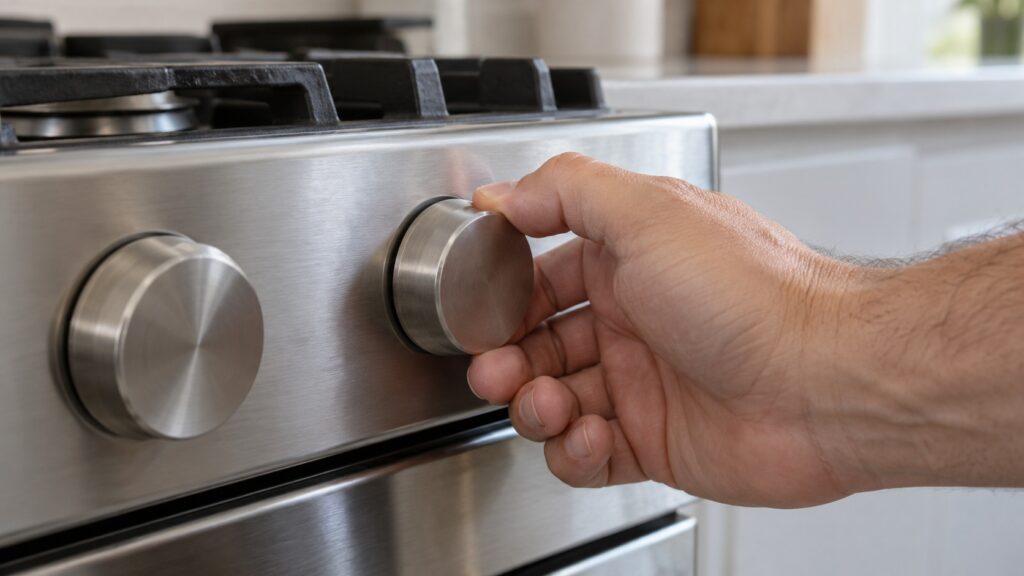
No. The knob is what you touch, and the power levels are how many steps the cooktop divides its output into. The HII8046U page mentions 11-stage power settings per element, and the HII8057U page describes an 11-stage power level system running from gentle melting to rapid searing. PreciseSelect is the control that lets you move through those steps. The two ideas are often written in the same sentence, which is why people confuse them.
AutoChef is a third idea. On the HII8046U page it is described as programs that automatically adjust time and temperature for specific dishes. The site does not list the programs, so do not assume a particular dish is included.
How do you care for PreciseSelect knobs?
Keep it simple. Our range cleaning guide notes that the knobs on most Bosch ranges pull straight off for cleaning and recommends spraying glass cleaner onto a cloth rather than directly onto a panel, so liquid does not run behind controls. Use that as a general rule, and confirm in your owner’s manual whether your particular knobs are meant to be removed.
Wipe grease and sauce off the knobs with a damp cloth and a drop of mild dish soap, dry them, and keep abrasive pads away from the metal finish. Do not pour water into the gap around the base of a knob. If a knob spins freely, wobbles, or stops matching what the cooktop is doing, stop using that element and ask a technician to look at it. Do not open the control panel or pull the range out to chase a wiring problem.
What problems are linked to knobs, and when should you call?
Most knob complaints come down to four symptoms. The knob feels loose on its shaft. The knob turns but the element does not respond. An element runs when you expect it to be off. The display shows a fault. None of these is something to fix by guessing, because the knobs sit in front of the controls and electronics.
The first thing to check is the simple stuff: that the range has power and that the pan is magnetic on an induction model. Our guide to an induction zone that is not heating explains the pan test and what usually follows. If the range shows a fault code, look it up in the Bosch error code database before you decide what to do next.
A range can be repaired in place in most cases, and a knob or a control component swap is usually far cheaper than a new range. We are an independent repair company, not the manufacturer, so if a part is not worth replacing we will say so. You can read how a visit works on the range repair page.