Bosch wine cooler repair or replace decisions turn on which part has failed and how old the unit is, much like any other appliance, but a wine cooler has one wrinkle the rest of the kitchen does not: its sealed refrigerant system is genuinely not something to open yourself, even to look at, which changes how a household should approach a first diagnosis.
What typically fails on a Bosch wine cooler?
A wine cooler is mechanically simpler than most kitchen appliances, which narrows the list of usual suspects. The compressor, on units that use one, is the component that moves refrigerant through the system and does the actual cooling — and it is also the most expensive single part to replace. Smaller and some undercounter units use a thermoelectric module instead of a compressor, which cools using an electrical effect rather than compressed refrigerant; these modules are simpler and generally less expensive to replace, but they also cool less aggressively and are more sensitive to a warm room.
Beyond the cooling source itself, the door seal is the part that fails most often across every wine cooler type. A worn or compressed seal lets warm air leak in continuously, which shows up as a unit that runs constantly and still cannot hold its set temperature — a symptom easy to mistake for a failing compressor. The interior fan that circulates cold air, and the control board that reads the thermostat and drives everything else, round out the short list of parts that actually fail with any regularity.
How does a compressor-based unit differ from a thermoelectric one for this decision?
The repair-or-replace math is genuinely different between the two cooling methods. A compressor-based wine cooler behaves like a small refrigerator: the compressor is a serious part to replace, and on an older unit that calculation looks a lot like a refrigerator compressor replacement — worth doing on a unit with years of life left in every other component, harder to justify on one nearing the end of its expected life anyway. A thermoelectric module is a lower-cost part and a comparatively simpler swap, which tips the balance toward repair more often, provided the household’s storage needs do not exceed what a thermoelectric unit can reliably hold in a warm room.
What does age and cost logic actually look like here?
A wine cooler under roughly five years old with a failed seal, fan, thermostat or control board is almost always worth repairing — those parts are inexpensive relative to the appliance and the rest of the unit has plenty of life left. A unit between about five and ten years old facing a compressor failure is the harder call: repair is often still worth it if the unit has otherwise been reliable, but it is worth weighing the repair cost against what a comparable replacement costs new, especially if the collection stored inside represents real value that a second failure would put at risk again.
Past roughly ten years, or on a second major failure within a couple of years of the first, replacement usually makes more sense — not because the unit could not be repaired again, but because a wine cooler nearing the end of its expected life is a poor candidate for a second significant repair bill. Our appliance lifespans guide gives broader context on where a wine cooler’s expected service life sits relative to other kitchen appliances.
Why should you never open the sealed refrigerant system yourself?
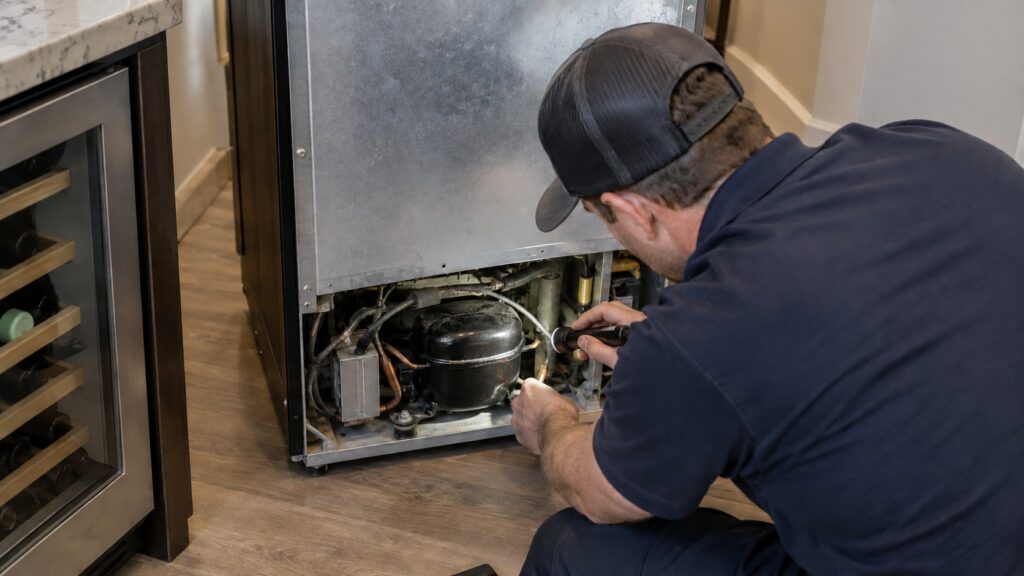
Every compressor-based wine cooler relies on a sealed loop of refrigerant under pressure, and that system is not designed to be opened, inspected or serviced by anyone without the equipment and training to recover and recharge refrigerant safely. Opening it releases the refrigerant, which is both a safety issue and, on most systems, an EPA-regulated substance that cannot simply be vented into a garage. It also means the cooling system cannot be reassembled and simply work again — once opened without proper recovery and recharge equipment, the unit needs professional service regardless of what the original problem was.
If you suspect a refrigerant leak — a wine cooler that runs constantly, never reaches its set temperature, and has a compressor that feels warm but not hot to the touch — that is a signal to call a technician rather than to investigate further yourself. This is the one category of wine cooler failure where a DIY first look genuinely is not the safe option.
What can you safely check before deciding anything?
Before assuming a major component has failed, rule out the ordinary things that mimic a bigger failure. Check that the door seal is making full contact around the frame and is not compressed or torn. Confirm the unit has enough clearance around the back and top to reject heat — a wine cooler built into cabinetry without proper venting will struggle to hold temperature and can look like a failing compressor when the real issue is airflow. Confirm the room temperature is within the range the unit is rated for; many wine coolers are not designed to hold their set temperature in a garage or an uninsulated space that swings far above room temperature.
Our wine cooler condensation troubleshooting guide covers a related symptom worth ruling out, since condensation and temperature problems often share the same seal and airflow causes.
Getting an honest number on a wine cooler
We are an independent repair company, not a factory service arm, so we have nothing to sell you on the replacement side. Where a repair is not worth doing, we say so and explain why. Pricing starts from a diagnostic visit and we confirm the estimate before any work begins. Bosch wine cooler repair covers seals, fans, control boards and compressor diagnosis, handled with the sealed refrigerant system by someone trained to service it safely, and you can schedule a visit online or call 1-844-731-6692.