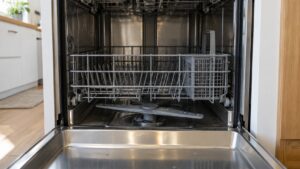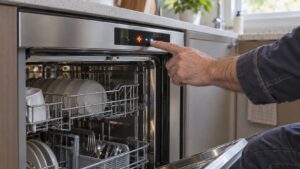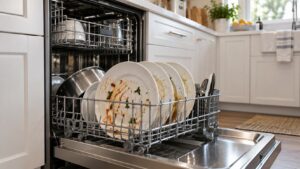
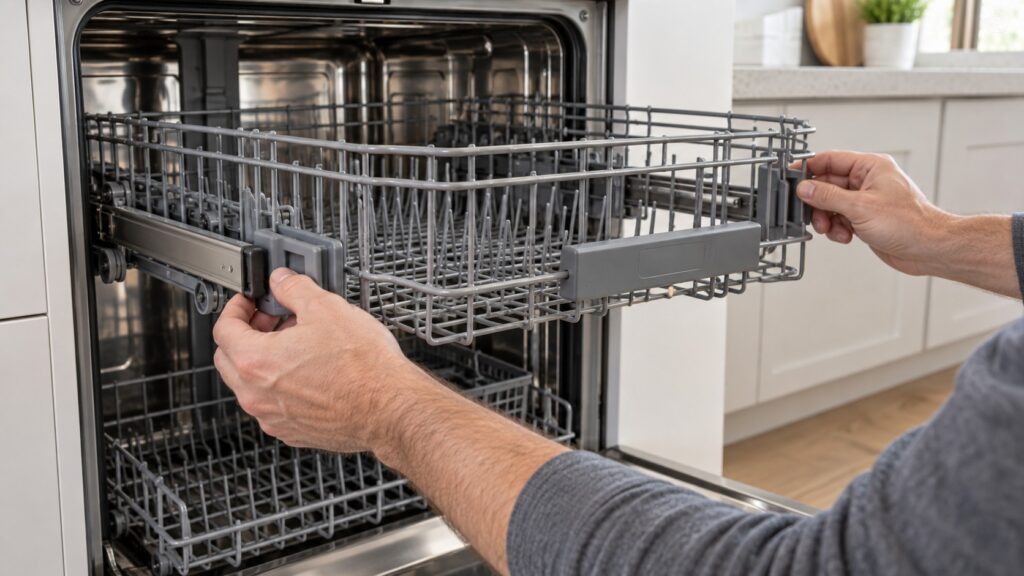
Bosch RackMatic is the adjustable upper-rack system that lets you raise or lower the top rack of a dishwasher in stages, even after it has been loaded, to make room for tall items on the bottom rack. Like any mechanism with moving rail clips and rollers, it needs occasional attention to keep working smoothly, and a rack that has become stiff or lopsided is usually a maintenance issue rather than a sign the rack has failed.
What is Bosch RackMatic and what problem does it solve?
Every dishwasher load is a compromise between rack height and item height, and a fixed-height upper rack forces that compromise every single time — either the upper rack sits low enough to leave the bottom rack cramped, or high enough that a stockpot or a platter cannot go in the bottom rack without hitting the rack above it. RackMatic solves this by letting the upper rack move up or down in stages along its rails, so the household decides on a per-load basis how much clearance the bottom rack gets.
The lever or tab that controls this sits at the front corners of the rack, usually one on each side, and lifting or releasing it lets that side of the rack slide along the rail to a new height. Most RackMatic systems let you make this adjustment even with dishes already loaded in the upper rack, which is the detail that makes it genuinely useful rather than a feature you set once and forget.
How do you actually adjust the RackMatic rack?
Locate the lever or tab at the front corner of the upper rack — most models have one on each side that can be operated independently, though some move the rack level on both sides at once from a single point. Lift or squeeze the lever as directed for your model, then slide the rack to the height you want and release the lever to lock it back into the rail. Do this on both sides if your model has independent levers, and check that the rack sits level afterward — an upper rack raised on one side and not the other will run unevenly and can bind against the rail over time.
Adjust the height before running a cycle with a tall item in the bottom rack, not partway through loading it — trying to force a stockpot underneath a rack that is still in its lower position, instead of raising the rack first, is the most common way the tabs get stressed or cracked.
Why does the rack get stiff or hard to move?
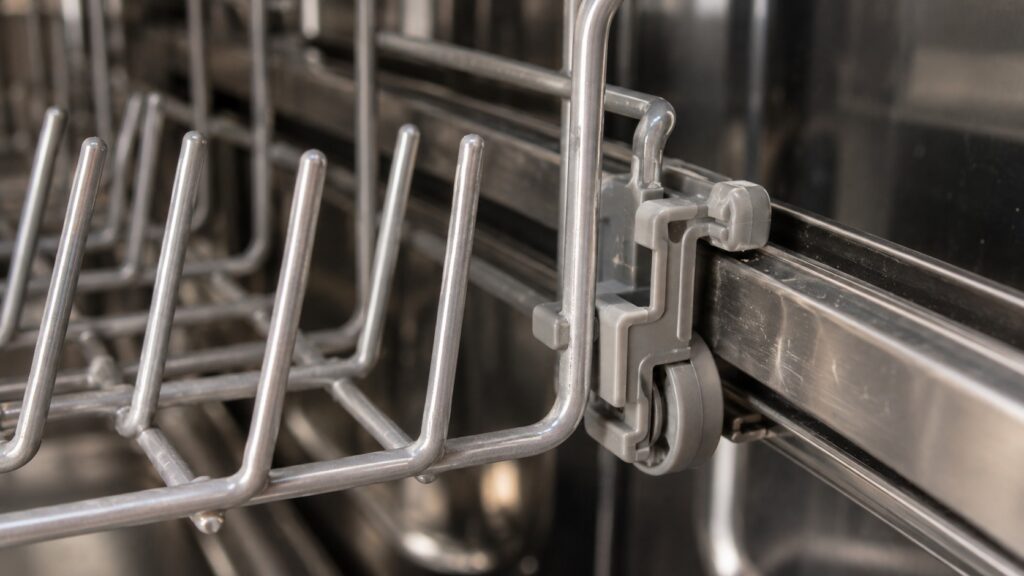
The rail clips and small wheels that the rack rides on accumulate the same residue everything else in a dishwasher does: dried food particles, grease film and hard water mineral buildup. Over months of use, that buildup coats the rail surface and the moving parts of the clip, and what was a smooth, one-hand adjustment starts requiring real force, or one side moves while the other sticks. This is the most common RackMatic complaint we see, and it is almost always a cleaning issue rather than a broken part.
Hard water areas see this faster than soft water areas, since mineral scale builds up on the rail track itself in addition to the clip mechanism. If your dishwasher already shows scale on the interior walls or the spray arms, expect the rack rails to need the same attention.
How do you clean and maintain the rack rails and clips?
With the rack empty, slide it to its lowest and highest positions a few times to work loose any dried debris, then wipe the rail track with a damp cloth to remove what has loosened. For mineral buildup, a solution of warm water and white vinegar on a cloth, worked into the rail and the clip mechanism, usually softens scale enough to wipe away without needing to disassemble anything. Check the small wheels or rollers the rack rides on for debris wrapped around the axle — a wheel that has stopped spinning freely drags rather than rolls, which is often mistaken for the rail itself being the problem.
- Every few months: cycle the rack through its full height range and wipe the rails.
- If scale is visible: treat the rails the same as the rest of the tub, with a vinegar rinse or a dishwasher cleaner cycle.
- Check for cracked tabs: a lever that has been forced past its stop point can crack at the hinge — inspect it if the rack ever came loose unexpectedly or one side moves while the other stays locked.
- Do not overload one side: heavy items stacked on one end of the rack stress the clip on that side disproportionately, especially when the rack is raised.
Our dishwasher filter cleaning guide is worth pairing with rail maintenance, since both jobs are part of the same routine care and both address hard water and food residue buildup.
Should you lubricate the RackMatic rail?
No — resist the urge to spray the rail or the clip mechanism with a household lubricant when it starts feeling stiff. A dishwasher rail sits inside a compartment that is repeatedly flooded with hot water, detergent and food residue, and any oil-based lubricant on that rail becomes a place for grease and debris to collect rather than a fix for the stiffness. It also risks depositing a film on dishes during the next cycle, which is not something you want on kitchenware.
The correct fix for a stiff RackMatic rail is the same cleaning routine described above: cycle the rack through its range to loosen debris, then wipe the rail and clip with warm water and, if needed, a vinegar solution for mineral scale. A clean, dry rail with the tabs and rollers free of buildup moves smoothly on its own — that is how the mechanism is designed to run, and it does not need any added lubricant to do it.
When is a RackMatic problem worth calling a technician for?
Routine stiffness that responds to cleaning is not a repair issue. A cracked tab, a lever that no longer locks the rack at any height, or a rack that has come off its rail entirely are mechanical failures worth having looked at, particularly if the rack now drops unexpectedly under a load’s weight — that is closer to a safety concern than a convenience one. If the surrounding spray system is also underperforming, our spray-arm maintenance guide covers the related parts of the tub that see the same mineral and food buildup.
We are an independent repair company, not a factory service arm. Bosch dishwasher repair covers rack, rail and clip replacement along with the rest of the dishwasher, and you can schedule a visit if a rack has stopped locking or has cracked at the lever.